Showing posts with label United States. Show all posts

Where is located Great Salt Lake?

Where is located Great Salt Lake
   The largest lake in the western half of the United States is Great Salt Lake. This lake is very different from the Great Lakes. For one thing, it is very shallow. On the average it is less than 15 feet deep. Besides, its water is very salty.
   This lake is left over from a much bigger one—Lake Bonneville. Lake Bonneville once covered most of what is now the state of Utah. It was a great fresh-water lake 1,000 feet deep. Water poured into it down the slopes of surrounding mountains. Through a gap in the mountains overflow water found a way to the sea.
   But in time the climate of the region became much drier. Less water ran into the lake, and much that did evaporated. Finally the lake was losing more water each year than it got. Of course, the lake became shallower and smaller. At last no water ran out of it to the sea. The lake grew salty, for the water as it evaporated left behind the salt it had gathered up from rocks on its way to the lake. Now the water is much saltier than sea water. The only living things in Great Salt Lake are brine shrimps and tiny algae. Swimming in such salty water is a strange experience. The water holds a swimmer up much more than fresh water does. If he floats, a third of his body is out of water. Diving is rather dangerous. A diver may be stunned when he hits the heavy water.
    Along the northwest shore of the lake are the Bonneville Salt Flats. "Flats" is a good name for them, for they are probably flatter than any other natural surface on the earth. The ground is almost pure salt. On the Flats there is an automobile racecourse. A racing car has traveled nearly 400 miles an hour on it.
   Salt Lake City is near Great Salt Lake. Some of the people of the city earn their living by mining salt. Lake Bonneville left behind enough salt to last the whole world for a thousand years.
   The best way to get a good view of the lake is to fly over it. On a sunshiny day the very blue lake with its border of salt makes a picture it is not easy to forget.

Confederate States

   In 1860 there were 33 states in the United States. But in December of that year South Carolina withdrew, or seceded, from the Union. In the first months of 1861, 10 more southern states seceded. They were Alabama, Arkansas, Florida, Georgia, Louisiana, Mississippi, North Carolina, Tennessee, Texas, and Virginia. These states formed the Confederate States of America. They chose Jefferson Davis as their president and Richmond, Va., as their permanent capital.
   These southern states wanted to set up a government of their own because they did not agree with the northern states about a number of things. One of the big disagreements was about slavery.    The South thought that it could not do without slaves. The North was against slavery.
   A bitter war was fought between the North and the South. The Confederate States lost the war. They became once more a part of the United States of America.

What is Imperialism?

   Imperialism, in its widest sense, is the exercise of unlimited rule over a vast extent of territory—such a sway as that at which Charlemagne aimed. Latterly, however, and especially in the United States, the term is used with reference to the policy of national expansion, and has been the cause of much controversy and conflict. Each acquisition of territory outside the continental limits of the United States has resulted in bitter criticism from the so-called anti-imperialists.


The Great American Desert

   The Great American Desert is a region in the United States roughly triangular in shape, including the area between the Rocky Mountains on the E, the Sierra Nevada on the W, the Salmon Mountains on the N, and the Sonoran Desert of Mexico to the S. Historically the name was applied to the entire western portion of the United States until careful exploration and settlement revealed the smaller limits of the area. The Great American Desert includes the GREAT BASIN, a major physiographic region, and several sub-regions which have been delimited because of individual characteristics. At the apex of the triangle in southern Oregon is the Great Sandy Desert, a high, treeless, chill area about 5,000 feet above sea level. Its floor is an ancient lake bed broken by volcanic cones. Malheur River is the only source of water, feeding Harney Lake (fresh) and Malheur Lake (saline). Burns, the only settlement, is one of the most remote cattle centers in the nation.

What are the Bill of Rights?

   The first ten Amendments to the Constitution of the United States are also called the Bill of Rights. Most of these rights protect the individual citizen against his government. Laws passed by Congress in conflict with the Bill of Rights may be overruled (declared unconstitutional) by the United States Supreme Court.
   The rights guaranteed in the first ten Amendments are rights that Englishmen had earned over many centuries, beginning with the Magna Carta in 1215. Some of the rights had been written into the charters of the various colonies. When the U.S. Constitution was completed in 1789, many people wanted the rights included so that the Federal Government would not become too powerful. The Constitution was accepted by the states with the understanding that Amendments, stating the rights of the people, would be made promptly. The ten Amendments making up the Bill of Rights were added in 1791.
   The first Amendment forbids the government to interfere with freedom of speech, freedom of the press, and freedom of religion. The Amendment also guarantees the right to ask the government for justice and to demonstrate peaceably. The second Amendment says that citizens have a right to possess arms (weapons). The third Amendment says that citizens cannot be forced to provide room and board for soldiers in their homes. The fourth guarantees that people or their property cannot be searched or taken away without a warrant (permission) that has been issued by a law officer.
   The fifth, sixth, seventh, and eighth Amendments have to do with fair and just treatment in the courts of law. A person cannot be tried twice for the same crime, and he cannot be forced to testify (speak out) against himself. He must be tried by a jury if he wants one, and the trial must be held in the area where the crime was committed. He must not be given cruel and unusual punishment.
   The ninth Amendment says that other rights not specifically mentioned in the Bill of Rights or the Constitution belong to the people. The tenth Amendment provides that powers not given specifically to the federal government shall belong to the States and the people.

Great Sand Dunes National Monument

   Great Sand Dunes National Monument, which comprises 36,609.19 acres in South central Colorado, was established in 1932. The monument is situated along the western base of the Sangre de Cristo Range, between Mosca Pass on the south and the Crestone Needles on the north, in the San Luis Valley. The shifting sand dunes are the last remnants of a once vast prehistoric desert. Rising more than 1,500 feet, these are among the largest and highest dunes in the United States. Many legends and superstitions are associated with the region.

Flag of the United States

   The flag of the United States, called the Stars and Stripes, originated during the Revolutionary War and was one of the first emblems to symbolize the nationhood of a people. Although Betsy Ross is credited with designing the flag, it is more likely that it was designed by Francis Hopkinson, a member of the Continental Congress; Betsy Ross was only the seamstress. The original flag, with 13 stripes and 13 five-pointed stars, was adopted in 1777. From 1795 to 1818 the official flag of the United States contained 15 stars and 15 stripes, the two extra stripes having been added for Vermont and Kentucky, the first new states to be admitted to the Union. It was this 15-stripe flag that inspired Francis Scott Key to write "The Star-Spangled Banner." In 1818 Congress adopted the plan of keeping the 13 stripes and adding to the number of stars as new states joined the Union. The 49th and 50th stars were added July 4, 1959, and July 4, 1960, for the new states of Alaska and Hawaii. The flag has officially been changed 27 times since 1777. The exact proportions for the flag were established by Woodrow Wilson in an executive order in 1916.


Emancipation Proclamation

   In 1861 a war broke out between the northern states and eleven southern states of the United States. The southern states wished to form a country of their own. Slavery was one of the causes of the war. Most of the people of the South believed in slavery. Many of them owned slaves. Most of the people of the North were against slavery. There were not many slaves in the North. Abraham Lincoln was the president of the United States when the war broke out. On September 22, 1862, he took a very important step. He proclaimed that on the next New Year's Day the slaves of the southern states were to be set free. The proclamation meant the freeing of about three million slaves. It is called the Emancipation Proclamation.

Who were the Buffalo Soldiers?

Buffalo Soldiers

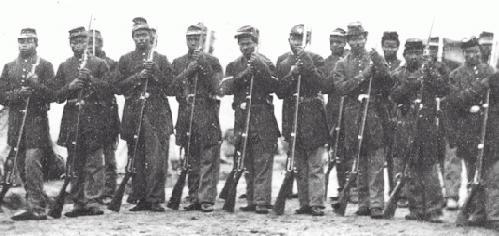
   The Buffalo Soldiers were African Ameri­can cavalrymen who fought in the Indian Wars in the American West. They belonged to the ninth and tenth regiments, which were created in 1866.

   The term "Buffalo Soldiers" was reportedly first used in the summer of 1867 when the black soldiers fought against Cheyenne warriors for the first time. The Cheyenne called the cavalrymen Buffalo Soldiers be­cause, like the buffalo, the men fought ferociously when cornered. And because the buffalo was sacred to the Native Americans of the Great Plains, the term must also have implied some respect for the soldiers. The members of the ninth and tenth regiments proudly accepted the name, and the tenth regiment's flag even had a buffalo on it.

One fact about earthquakes

Did you know?

The United States experiences an average of two earthquakes a day.

Who was Black Hawk?

Black Hawk chief
   The chief named Black Hawk (1767-1838) led the Sauk and Fox Indians in Illinois. In 1804, the Sauk and Fox tribes agreed to give their lands east of the Mississippi River to the United States. But Black Hawk thought the agree-ment was unfair. He and about 500 warriors joined the British in fighting against the U.S. during the War of 1812.
   Most of the Sauk and Fox Indians had left their homes and settled in a reservation west of the Mississippi by 1830. Black Hawk still refused to move. When white settlers began to take over the land, he led his men in a rebellion known as the Black Hawk War. After several victories, the Indians suffered a painful defeat in 1832. Black Hawk finally surrendered and was sent to live on a res­ervation in lowa. The failure of his rebellion marked the end of Indian settlement in Illinois.

Who won the Battle of Gettysburg?

The Battle of Gettysburg was an engagement of the Civil War, which is considered to be the turning point in the struggle between the North and South, occurred at Gettysburg, Pa., July 1, 2, and 3, 1863, between the Army of Northern Virginia commanded by General Robert E. Lee, and the Army of the Potomac commanded by General George G. Meade. Lee's forces numbered 70,000 and the Union forcees 93,500. About 100,000 including volunteers took part in the engagement on the Union side.

Lee began the invasion of the North June 3 and was followed by Meade. The advance divisions of the opposing armies faced each other at Gettysburg on the morning of July 1. The Confederate line was on Seminary Ridge west of the town, and the Union line on Cemetery Ridge to the south. The battle raged for two days without any decisive result. On July 3 came the crucial test, when after a prolonged cannonade, Lee ordered General Pickett to charge the Union lines. The Confederate forces carried the first line of the Union defense, but here they were halted by a withering fire and compelled to retreat. This was the end of the bat­tle. On the morning of July 5 Lee's army was in full retreat southward. Meade's forces were so depleted that he was unable to follow. The Union losses were officially estimated at 23,000 and the Confed­erate at 20,450.

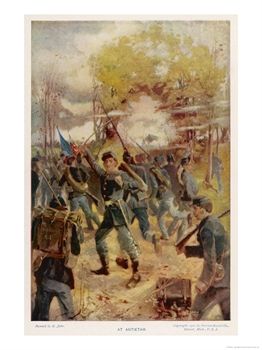
The bloodiest single-day battle in American history. The Battle of Antietam

The Battle of Antietam or Battle of Sharpsburg, was an famous combat of the Civil War. About fifty thousand Confederate troops led by General Robert E. Lee attempted an invasion of the North. His troops were intercepted on Sept.17, 1862, near Sharpsburg, Md., by a Union army of seventy thousand men under the command of General George Brinton McCIellan. In the ensuing action,  the Union army suffered approximately 12,000 casualties, including 2108 killed; at least 2700 Confederate soldiers were killed, and about ten thousand were wounded or missing. Lee's army retreated across the Potomac River the following day, making the outcome technically a Union victory. The Battle of Antietam was the bloodiest single-day battle in American history, with about 23,000 casualties.
The name of the battle is derived from Antietam Creek, near the battle area; the area was designated a national battlefield site in 1890.  Antietam National Cemetery is in the vicinity.

Fort Lauderdale - interesting facts

  • Fort Lauderdale is a city in the U.S. state of Florida.
  • Ft. Lauderdale had a population of 184,892 (est. 2007).
  • The month of August is the hottest in Ft. Lauderdale.
  • Ft. Lauderdale is a popular tourist destination, with 10.35 million visitors in 2006.
  • European contact with the region began in the 1500s.
  • Nickname: The "Venice of America".
  • Temperatures in this tropical climate average 77 degrees F (25 degrees C) year round.
  • Ft. Lauderdale is a major yachting center, with 42,000 resident yachts and 100 marinas and boatyards.
  • Fort Lauderdale has a total area of 93.2 km² (36 square miles), 82.1 km² (31.7 square miles) of which is land and 11.1 km² (4.3 square miles) of which is water (11.91 percent).
  • Ft. Lauderdale was incorporated as a municipality in Florida in 1911.
  • Ft. Lauderdale is named after a series of forts built by the U.S. during the 2nd Seminole War. 
  • The city is known for its extensive network of canals.
  • Fort Lauderdale became a Naval and Coast Guard base during World War II.

Facts about the Everglades

  • The Everglades stands as the third largest national park in the United States after Death Valley and Yellowstone.
  • The Everglades National Park is visited on average by 1,000,000 people each year.
  • Total Area1, 2,335 square miles (6,110 km2).
  • Creation Date May 30, 1934
  • Unlike most U.S. national parks, Everglades National Park was created to protect a fragile ecosystem instead of safeguarding a unique geographic feature.
  • Highest Elevation 9 feet on Totten Key
  • 50 species of reptiles live within Everglades National Park.
  • The park was established in 1934 to protect the quickly vanishing Everglades and dedicated in 1947.
  • The Everglades is actually a very slow-moving river.
  • Over 40 species of mammals are found in Everglades National Park.
  • The Everglades is the only place in the world where the American Crocodile and the American Alligator co-exist in the wild.

United States of America - Facts

  • Washington, D.C. is the capital of the United States of America founded on July 16, 1790.
  • New York City is the most densely populated major city in the U.S. (8.4 million).
  • Contrary to many people, no star on the flag is specifically representing any one state. In fact, no law exists as to how they are even to be arranged.
  • The "largest" city in the U.S. is Juneau, Alaska (3,000 sq miles)
  • July 4, 1776, is the "official" date when the United States was born, but actually was not one country until 1788.
  • The country is a federal constitutional republic comprising 50 states and a federal district.
  • The first capital in the United States was New York City.
  • Martin Van Buren was the first president born in the United States after it declared its independence from England.
  • The United States of America is the third or fourth largest country by total area, and the third largest both by land area and population.
  • There are 140 towns and cities in the United States that have the word "Christmas" in their names.
  • The United states accounts for 40 percent of global military spending.
  • Population: 310 million.
  • John F. Kennedy is the only U.S. president to have died before his parents.
  • Area: 3.79 million sq mi (9.83 million km2)
  • The first gold rush in the U.S. happened in Dahlonega, Georgia, 1828.
  • Before 1913, the United States had no income tax.
  • Death Valley is the lowest point in the United States.
  • The largest meteorite crater in the U.S. is in Winslow, Arizona. 4,000 feet (1,200 m) across and 570 feet (170 m) deep.
  • The oldest capital city in the United States is Santa Fe, New Mexico, founded in 1610.
  • In 1918 the Spanish flu killed 548,000 people in the United States.
  • Boulder, Colorado is the only city in the U.S. to own a glacier.
  • Oprah was the highest paid television entertainer in the U.S. in 2006, earning an estimated $260 million during the year, 5 times the sum earned by second-place music executive Simon Cowell.
  • Hawaii is the only U.S. state that grows coffee.
  • The first U.S. Mint was in Pennsylvania.

Facts about tourism
Facts about airports
.


Facts about Will Smith

Dallas, Texas - interesting facts

  • Dallas is the 3rd-largest city in Texas.
  • The 7-Eleven chain, started in Dallas, Texas in 1922.
  • Dallas has a total area of 385 sq mi (997.1 km2).
  • The frozen margarita machine was invented by Dallas restauranteur Mariano Martinez in 1971.
  • Fox’s “Prison Break” and CBS’ “Walker: Texas Ranger” were filmed in Dallas, Texas.
  • One in eleven Dallas-area workers is employed by the hospitality industry.
  • Dallas, Texas has the 9th largest population in the U.S.
  • The average year-round temperature ranges from 55 °F (13 °C) to 76 °F (24.5 °C).
  • Dallas, Texas is one of the 10 largest municipalities in the United States.
  • Texas state is larger than Belgium, Holland, France, Luxembourg and Switzerland combined.
  • The integrated circuit computer chip was invented in 1958 in Dallas.
  • On Nov. 22, 1963, President John F. Kennedy was assassinated in Dallas, Texas.

Declaration of Independence - interesting facts

  • The anniversary of the United States of America—Independence Day—is celebrated on July 4, the day the wording of the Declaration was approved by Congress.
  • The Declaration of Independence is considered to be the founding document of the United States of America.
  • John Hancock was the first and only person to sign the Declaration on July 4, 1776.
  • The remaining fifty-four delegates did not sign the Declaration of Independence until August 2, 1776.
  • The youngest person to sign the Declaration was 26-year-old Edward Rutledge and the oldest was 70-year-old Benjamin Franklin.
  • Thomas Jefferson is the actual author of the Declaration of Independence.
  • Jefferson wrote the Declaration of Independence in under 3 weeks.
  • Thomas Jefferson died on July 4, 1826.
  • The adoption of the Declaration of Independence was dramatized in the 1969 Tony Award-winning musical play 1776, and the 1972 movie of the same name, as well as in the 2008 television miniseries John Adams.
  • The engrossed copy of the Declaration is central to the 2004 Hollywood film National Treasure, in which the main character steals the document because he believes it has secret clues to a treasure hidden by some of the Founding Fathers of the United States.
  • "We hold these truths to be self-evident, that all men are created equal, that they are endowed by their Creator with certain unalienable Rights, that among these are Life, Liberty and the pursuit of Happiness."
Enhanced by Zemanta

Interesting facts about California

  • California is the most populous state (36,961,664) in the United States and the third-largest by land area, after Alaska and Texas. 
  • California adjoins the Pacific Ocean, Oregon, Nevada, Arizona, and the Mexican state of Baja California. 
  • California's first Spanish mission (San Diego) was not established until 1769.
  • California became a U.S. territory in 1847.
  • When California gained statehood in 1850, San Jose served as its first capital.
  • By 1964, California had surpassed New York to become the most populous state.
  • Its five largest cities are Los Angeles, San Diego, San Jose, San Francisco, and Long Beach.
  • Almost 40 percent of California is forested.
  • Death Valley, in the southeast, is -86 m (282 ft) below sea level, the lowest point in the nation.
  • Mt. Whitney 4,418 m (14,491 ft) is the highest point in the contiguous 48 states.
  • California has a varied climate and geography and a multi-cultural population.
  • Gray Davis was the first governor of California, and second governor in American history, to be recalled by voters.
  • If California were a country, it would rank among the 10 largest economies in the world, with a GDP similar to that of Italy.
  • If it were a country, California would be the 59th-largest in the world in area.
  • The Central Valley is California's agricultural heartland and grows approximately one-third of the nation's food.

Quick facts about Anaheim, California

  • Anaheim is a city in Orange County, California.
  • Incorporated as a city for the first time in 1870, Anaheim is the tenth largest city in California.
  • Anaheim is the site of the Disneyland Resort, a world-famous grouping of theme parks and hotels which opened in 1955.
  • In 2001, Disney's California Adventure, since renamed Disney California Adventure in 2010, the most expansive project in the theme park's history, opened to the public.
  • Anaheim is home to approximately 353,643 inhabitants.
  • Founded by fifty German families in 1857 and incorporated on February 10, 1870, Anaheim developed into an industrial center, producing electronics, aircraft parts and canned fruit.
  • Anaheim is part of the Los Angeles-Long Beach-Santa Ana metropolitan area which is home to over 12 million people.
  • In the late 20th century, Anaheim grew rapidly in population. Today, Anaheim has a diverse ethnic and racial composition.
  • August average daily high and low temperatures are 85.6 and 63.4 degrees Fahrenheit. January average daily highs and lows are 68.6 and 45.2 degrees Fahrenheit. Annual precipitation is about 11 inches.
  • The first star to be placed on the Anaheim Walk of Fame was Walt Disney, the man most responsible for making Anaheim the hugely popular tourist destination it is today.