Showing posts with label general knowledge. Show all posts

Where is the world's largest tomb?

the world's largest tomb Nintoku tomb

Nintoku was a Japanese emperor who ruled in the fourth or fifth century after Christ.

According to a legend, Nintoku wanted his brother to became emperor instead of him, so he refused to take his throne for three years. His brother also refused to become emperor, and eventually committed suicide to ensure that Nintoku would rule.

Another legend says that one day Nintoku looked over his village from an elevated tower, and noticed that there was no smoke coming from any of the houses he observed. He realized that people did not have rice to cook, so he used the wealth of his palace to distribute food to the poor in Japan.

Nintoku's body is supposed to rest under a mound in Sakai, Osaka, the city that was the capital during Nintoku's reign. This mound, called Daisen Kofun, is the largest tomb in the world. It is 463 meters long, about 300 meters wide, and 45 meters high.

.

When was the first film made in the United States?

When was the first film made in the United States?
Life of an American Fireman.
In the early days of movies, people were so excited by the sight of moving images that it didn't matter what they saw on the screen.

The first films were very short and showed ordinary things: couples dancing, men struggling, trains moving, or just pictures of famous people like Buffalo Bill and Annie Oakley.

But then in 1903, a cameraman named Edwin Porter put a series of short pieces together, filming some more segments, and produced a film called Life of an American Fireman. About a year later, Porter filmed The Great Train Robbery, the first movie where there was a plot, and the first movie ever seen in a movie theater in the United States.

Before Hollywood, the center of cinematography was in New Jersey!

.

What was the first sound film?

What was the first sound film?At first the movies had no sound. A pianist in the theater played the music throughout the movie, but there were no spoken words in those early movies. The actors' words were subtitled on the screen between scenes.

Then, in 1926, a movie called Don Juan appeared with a soundtrack. But the soundtrack was independent of the movie, and was simply played in the theater along with the movie. In addition, there was no dialogue about the soundtrack, only the music.

The Jazz Singer, which first appeared in 1927, is often called the first movie to be "talking" because it contains a few dialogue words apart from the music. But this film is not all-talking. The first film that was actually a talking picture, with all the dialogue on the soundtrack, as we know it today, appeared in 1928, and was called Lights of New York.

The first full-length color film to be shown to the public, Toll of the Sea, appeared in 1922, five years before the first sound film!

.

What country eats more fruit?

What country eats more fruit?

On Christopher Columbus' travels to the New World, he never set foot in what is now the United States, but on his fourth and final trip, Columbus arrived in Central America, on a cape that is now part of the nation of Honduras.

Similar in size to the state of Pennsylvania, Honduras has a long Atlantic coastline and a shorter Pacific coastline. The name Honduras comes from of the depths of the coastlines and that enter between the hills and valleys of the Honduran coastline.

The population of Honduras is about 9,112,867 and is growing faster than any other nation in the Western Hemisphere. The hundreds of thousands of El Salvador's neighbors who have moved to Honduras count a lot in this increase.

Bananas are Honduras' main export. Hondurans eat more fruits per capita than people from any other country in the world, about 244 kilos per person per year, more than double the U.S. average.

.

How deep is the deepest lake on Earth?

How deep is the deepest lake on Earth? Baikal

Lake Baikal is a narrow lake in Siberia, not far from the Mongolian border. The lake is about 636 kilometers long and 80 kilometers wide. It is the eighth largest lake in the world. But the first in terms of quantity of water.

But Lake Baikal is not known only for its size, but for its depth. At a certain point, the bottom of Lake Baikal is more than 1,642 meters below its surface.
If three Empire State buildings piled one on top of the other at the bottom of Lake Baikal, the building above would not reach the surface of the lake!

With an area of 31,494 km², Lake Baikal is the largest freshwater lake in Asia and, as mentioned earlier, the deepest in the world. It contains 23,600 km³ of water, equivalent to 20% of the world's freshwater.

.

What is the cold pole?

What is the cold pole? Verkhoyansk

The "cold pole" is a region of Siberia that is considered the coldest place on Earth outside Antarctica. Temperatures in this part of Siberia are generally much lower than in the North Pole itself about 2,400 kilometers away, partly due to the high altitude of this region.

Temperatures at the North Pole are probably not below minus 52 °C (-61.6 °F).

But in Verkhoyansk, a settlement near the "cold pole," the temperature often drops below -62.2 °C (-79.6 °F). The temperature once reached a minimum of -67.8 °C (-90.04 °F)!

Interestingly, in summer the temperatures around the cold pole can be quite hot. Once a temperature of 37 °C (98.6 °F) was recorded in Verkhoyansk, giving this place a temperature range of 105 °C (221 °F), the highest on Earth!

A few hundred kilometers from Verkhoyansk is the village of Oymyakon, the coldest place on Earth that is permanently inhabited. The lowest temperature recorded in Oymyakon (though not considered official) has been -71.2 °C (-96.16 °F) below zero.

But undoubtedly the coldest place on the planet (and the other "coldest pole"), is in Antarctica, specifically in the Antarctic station of Vostok, which recorded on July 21, 1983 a temperature of -89.2 °C (-128.56 °F)!

.

What place was called the copper island?

What place was called the copper island? Cyprus

Cyprus, the third largest island in the Mediterranean Sea, is located 70 kilometres south of Turkey and 96 kilometres off the coast of Syria.

With an area of 9,251 km² , the island is the size of Puerto Rico. Some 611,000 are Greek Cypriots, while some 142,000 are of Turkish origin.

In ancient times, Cyprus was famous for its copper mines. In fact, the name of the island gave rise to the word kypros which is what the Greeks called copper. This Latin word is Cuprum and from which comes our modern word for copper.

Over the centuries, Cyprus has been conquered and ruled by many peoples, including the Egyptians, Phoenicians, Persians, Greeks, Romans, Turks and Crusaders. The British gained control of the island in the 19th century, and Cyprus did not become an independent nation until 1960.

After independence, many Greek Cypriots on the island wanted to be part of Greece, while the Turkish Cypriots wanted to divide the island between the Greeks and the Turks who lived there. A civil war in 1974 caused Turkish troops to invade Cyprus and conquer the northern part of the island.

Cyprus is still divided today. The southern part is populated by the Greeks and is called the Republic of Cyprus. The north, Turkish part was declared independent in 1975, and established a government of its own, although it is not recognized by the United Nations.

Today, Cyprus still produces small quantities of copper. But it is best known for its wine and cigarettes. In relation to its population, Cyprus produces more wine and cigarettes than many countries on Earth.

.

What people used the first lamps?

What people used the first lamps?

 The first lamps we know of were used by primitive man, perhaps before 50,000 BC.

These lamps consisted of a stone in the form of a container filled with animal fat or vegetable oil, whether olive or dried fruit. A piece of moss was inserted in the oil, then it would light up. The moss served as a wick, absorbing the oil and burning slowly to give light.

After people learned to make clay objects, clay lamps were made instead of stone ones. Clay lamps have been found that probably date back to 4000 BC.

.

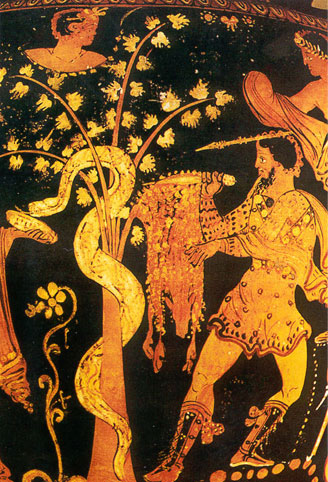
The legend of Jason and the Argonauts

The legend of Jason and the Argonauts Is the Greek legend of Jason and the Argonauts true?

The history of Jason and the group of Greeks known as the Argonauts is one of the oldest and best-known legends of ancient Greece.

According to the legend, a Greek prince named Jason was charged with the task of finding and returning to Greece the golden fleece, which came from the skin of a golden ram. When the ram was sacrificed its skin was hung in a forest, guarded by a dragon that never slept.

Jason departed in a ship called Argos, the first warship ever built. After many adventures, Jason and his men reached Colchis, a land on the eastern shore of the Black Sea. The king of the place forced Jason to perform a series of tests.

One of these tests was to put the plow yoke on a pair of bulls exhaling fire. After successfully performing his test, Jason planted a field with the teeth of a dragon, from which armed men were born. Then, aided by the sorceress Medea, Jason managed to take the golden fleece and return to Greece.

This story was well known before the Greek poet Homer was born. For a long time it was considered a mere legend. But a few years ago, a stone with the inscription of an ancient period was found in Maikop, Russia, in what was once the Colchis. The stone tells a possible version of Jason's story. It speaks of a trip to the region by a group of Greeks during a previous period.

The legend of Jason and the Argonauts is now believed to represent a true journey by ancient Greeks to the shores of the Black Sea. The golden fleece that Jason and his men were looking for perhaps represented the gold that abounded in the ancient land of Colchis.

.

Has chocolate always been popular?

Has chocolate always been popular?

Before Christopher Columbus set sail for the New World, no one in Europe had ever heard of chocolate. It wasn't until Spanish explorers arrived in Mexico, where cocoa beans grew, that Europeans were introduced to the world of chocolate.

It was the Aztecs who showed the Spaniards how to prepare a drink from cocoa beans, and it was from these explorers that chocolate was introduced to Spain.

However, chocolate did not become popular in countries other than Spain until the mid seventeenth century. And even then, and for a long time, Europeans only enjoyed chocolate in drink form, never in solid form, as we do today. Solid bars of chocolate to eat were not invented until 1876!

Strangely enough, even today, chocolate is not popular in most parts of the world. It is grown mainly in Africa and Latin America, but few people in the world eat it. The United States and nine European countries consume most of the chocolate produced in the world.

The Aztecs believed that eating cocoa beans gave them the wisdom and knowledge of the gods!

.

When did people start drinking coffee for the first time?

When did people start drinking coffee for the first time?

Coffee is so popular today that you might think people have always been drinking it. But most of the world started drinking coffee just a few hundred years ago.

Coffee plants first grew wild in East Africa and Arabia. Around 850, according to an Arab legend, a young goat herder was guarding his herd when he noticed that his goats began to act excitedly after eating the berries of a shrub. The goatherd tasted the berries and found that they tasted good. Coffee soon became popular throughout Arabia, and eventually spread to Europe during the 16th and 17th centuries.

Until 1700, all the coffee in the world came from Arabia, as the Arabs guarded the secret of how it was grown. Eventually, a Dutch merchant smuggled some coffee plants and planted them on the island of Java in the East Indies. Soon, much of the coffee consumed in the world came from this place, so it began to be known as "Java".

Some French traders planted coffee in South America and kept the way it was grown a secret. However, a Brazilian soldier won the heart of a French woman, and she gave him some coffee seeds. The Brazilians then began to grow their own coffee, and today Brazil is the largest coffee producer in the world.

Americans drink about 1,200,000,000 kilos of coffee a year - equivalent to one-third of all the coffee produced worldwide.

.

What city is known as the "Venice of the North"?

What city is known as the "Venice of the North"?  St. Petersburg

 In the early 18th century, the Russian Tsar Peter I decided to build a new city to serve as an outlet for Russia in the Baltic Sea. The site was chosen on the Neva River, near the Gulf of Finland.

Because the region was very swampy, the city had to be built on piles sunk in the swampy land. This caused many people to die while working in this cold and humid region.

The new city, named St. Petersburg, was called "the city built on bones".

St. Petersburg served as the capital of Russia from 1703 to 1917. During the period of the Soviet Union it was known as Leningrad. St. Petersburg is sometimes called the "Venice of the North", as it is built on 101 islands and contains about 320 kilometers of navigable waterways.

The population of the city was more than 3 million when World War II began. The Germans attacked the city and prevented supplies from reaching Leningrad for more than 500 days.

About 1.3 million people died during the Nazi siege of Leningrad, many of them starving. Some 500,000 victims of the siege are now buried in a cemetery in the city, the largest cemetery in the world.

.

Where was tea first drunk?

Where was tea first drunk?

In 2737 BC, a Chinese emperor named Shen Nung was boiling a pot of water on top of a fire. One of the leaves feeding the fire fell into the container.

When the emperor drank the water, he found that it tasted delicious. What kind of leaf was it that gave the water its flavor? The leaf came from a perennial shrub called Camellia sinensis - better known to us as tea.

This story is just a legend. But tea was discovered in China or neighboring lands thousands of years ago. It spread throughout the East, but for many centuries it was only drunk as medicine.

Then the Chinese learned to roast the leaves - as Shen Nung's fire had done - to make the drink taste better, and people started drinking tea as a refreshing drink instead of a medicine.

Although India is the world's largest tea producer, tea was not grown in the country until the nineteenth century.

The largest tea consumers in the world are, of course, the English.

.

What's the biggest lake in the world?

What's the biggest lake in the world? Caspian seaThe Caspian Sea is the largest lake on Earth. It is four times larger than Lake Superior, the second largest lake. However, the Caspian Sea was once much larger, and today, its area continues to decline.

The Caspian Sea is surrounded by Russia, Azerbaijan, Iran, Turkmenistan and Kazakhstan.

An inland sea once covered the region around the Caspian Sea. Its exact magnitude is unknown, but it reached at least as far as the Aral Sea in the east, and the Azov Sea in the west.

In more recent times, the Caspian Sea filled an enormous depression between the borders of Russia, Turkmenistan and Iran. This region, the largest exposed depression on earth, has an area of more than 520,000 square kilometers. The Caspian Sea now fills only 371,000 km² of that depression. The coasts of this sea went 400 km into what is now the mainland.

In more recent years, the level of the Caspian Sea has dropped by about 20 metres. Its surface is 28 metres below sea level.

The salinity level of the Caspian Sea is one third that of the ocean.

.

When was aspirin discovered?

When was aspirin discovered?

Ancient Egyptians, Greeks, and American Indians sometimes chewed the leaves of the willow tree and other plants to relieve pain. But no one knew why these plants helped fight pain until the nineteenth century, when scientists found that these plants contained pain-relieving substances called salicylates.

But in their pure form, these substances make people nauseous. So, in 1898, a German chemist named Felix Hoffman found a way to make a salicylate-based medicine that wouldn't upset the stomach. This new drug was called acetylsalicylic acid, although today it is better known as "aspirin".

At first, aspirin was sold by prescription only, and was served in powder form. Aspirin tablets did not appear until 1915. Today, Americans take about 30 billion aspirins a year - about 100 per person - and aspirin is by far the most widely used drug in the world!

.

Why do clocks in advertising mark 10:10?

Why do clocks in advertising mark 10:10?Why do new watches and watches in advertising usually mark 10:10? Many conjectures have been made in this regard. We will try to explain the real reason for 10:10.

First things first, and let's leave the myths out. There are a lot of people out there who think that clocks in advertising and store ads show the time when Abraham Lincoln, John F. Kennedy and Martin Luther King died. In fact, Lincoln was shot at 10:15 p.m. and died the next morning at 7:22 p.m., JFK was killed at 12:30 p.m. and declared dead at 1 p.m., and Martin Luther King was shot at 6:01 p.m. and declared dead one hour later at 7:05 p.m. JFK was shot at 6:01 p.m. and declared dead one hour later.

Another theory says that it was at 10:10 the time an atomic bomb was dropped on Hiroshima, or in Nagasaki, and that such time is in the memory of the victims who survived. The truth is that the bomb 'Fat Boy' fell on the first city at 11:02 in the morning, local time; and the bomb 'Little Boy' was dropped on Nagasaki at 8:15 in the morning, local time.

But what was the real reason for establishing such a time? Simple aesthetics. The 10:10 position gives the watch a series of benefits:

-The hands do not overlap, so they are full and clearly visible and their style can be admired.

-The arrangement of the hands is symmetrical, which is more pleasant than an asymmetrical position, making the product more attractive to customers.

-The manufacturer's logo, usually in the middle of the dial on the 12 o'clock frame, is not only visible, but is very well framed by the hands.

-Additional elements on the cover (such as the date window) are usually placed close to 3, 6, or 9, so that they are not hidden by the hands.

According to Timex people (who set the time of their clocks at 10:09:36 exactly), the old standard configuration used was 8:20, but this made the cover seem to frown. To give it a "happier" face, the time was set to a smile (sometimes you can still see the 8:20 arrangement on some watches when the manufacturer's logo is on the bottom of the cover above 6).

.

When was bread first made?

When was bread first made?

Mankind has been making some kind of bread for over 10,000 years.

The first men probably chewed the seeds of wheat and other cereals, either raw or toasted. Some time later, primitive people learned to crush cereal grains between two stones, separate the cover from the seeds, and turn starch and other elements into a powder (flour). The powder could be mixed with water to form the dough, and it could then be put on fire.

The ancient Egyptians and the Hebrews were the first to discover that the fermented dough - a yeast dough - produced lighter and better tasting bread. The Egyptians were probably also the first to bake white wheat bread. But even as late as the 17th century, English peasants rarely ate white bread, as the most common bread they made was barley and rye.

The work of milling wheat into flour was an arduous task until around 200 BC, the first milling machines were invented. Later, waterwheels and windmills were used to move the large stones that ground the wheat.

Bread has always been important because of its low cost and high nutritional value. Bread is so important all over the world that it is called "the provider of life."

A 3,500 year old loaf of bread was found in an Egyptian tomb!

.

When did the custom of exchanging wedding rings begin?

custom of exchanging wedding rings

Not everyone in the world is in the habit of exchanging rings when they get married. But in some places, the custom has been followed for so long that no one knows when it actually began.

In some primitive tribes, it was a custom for a man to place a bracelet on the arm or leg of the woman he married to prove that she belonged to him. This custom may have led to the first use of the wedding ring.

Wedding rings were already in use since ancient Egypt. The Egyptians believed that the circle represented eternity, and therefore the ring would keep the marriage forever.

Wedding rings have been placed on the fourth finger of the left hand since the times of ancient Greece. The Greeks believed that a vein from this finger ran directly to the heart.

.

Where are the highest sand dunes in the World?

Where are the highest sand dunes in the World?

The central part of Algeria, in the Sahara desert, is a region of large quantities of sand. The sand is accumulated by the wind in massive dunes.

In some places, these dunes are so large that the ridges of neighboring dunes can be five kilometers away. One particular sand dune in this region is the highest in the world, reaching a height of 420 meters, higher than the Empire State Building in New York!

Huge sand dunes are not only found in the desert. There is a sand dune near the village of Arcachon, in France, which is about 100 meters high.

.

What are the driest islands in the world?

What are the driest islands in the world? Cape Verde

Cape Verde is a cape in the westernmost part of Africa. It is also the name of a group of islands in the Atlantic Ocean, about 650 kilometers from Cape Verde in Africa. It is an archipelago consisting of ten islands and five islets, this nation has an area of only 4,033 km².

The Cape Verde Islands were discovered in 1460 by Portuguese sailors. The islands were uninhabited when they were discovered, today they have a population of around 539,560 people. Portuguese is the official language, but each island has its own dialect. Cape Verde became an independent nation in 1975.

The islands of Cape Verde are of volcanic origin, and seven of the largest islands are mountainous. One of the peaks found on the Islands is over 2,700 meters high, higher than any mountain in Portugal, or anywhere else that was once the vast Portuguese empire!

Situated at the same latitude as the Sahara desert, the Cape Verde Islands are warm and dry. Drought is always a problem, even though the nation is surrounded by water.
Cape Verde is very poor, with no railways, no infrastructure and only a few telephones. Much of the country's income comes from recharging ships and planes on their way to other places.

.