Showing posts with label legends. Show all posts

Where is the world's largest tomb?

the world's largest tomb Nintoku tomb

Nintoku was a Japanese emperor who ruled in the fourth or fifth century after Christ.

According to a legend, Nintoku wanted his brother to became emperor instead of him, so he refused to take his throne for three years. His brother also refused to become emperor, and eventually committed suicide to ensure that Nintoku would rule.

Another legend says that one day Nintoku looked over his village from an elevated tower, and noticed that there was no smoke coming from any of the houses he observed. He realized that people did not have rice to cook, so he used the wealth of his palace to distribute food to the poor in Japan.

Nintoku's body is supposed to rest under a mound in Sakai, Osaka, the city that was the capital during Nintoku's reign. This mound, called Daisen Kofun, is the largest tomb in the world. It is 463 meters long, about 300 meters wide, and 45 meters high.

.

The legend of Jason and the Argonauts

The legend of Jason and the Argonauts Is the Greek legend of Jason and the Argonauts true?

The history of Jason and the group of Greeks known as the Argonauts is one of the oldest and best-known legends of ancient Greece.

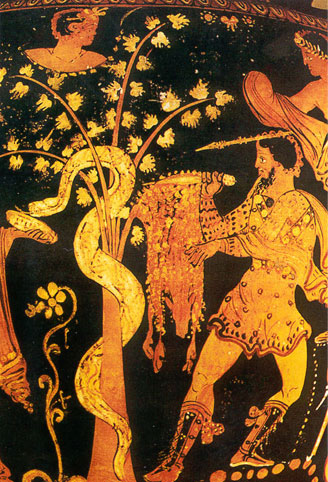
According to the legend, a Greek prince named Jason was charged with the task of finding and returning to Greece the golden fleece, which came from the skin of a golden ram. When the ram was sacrificed its skin was hung in a forest, guarded by a dragon that never slept.

Jason departed in a ship called Argos, the first warship ever built. After many adventures, Jason and his men reached Colchis, a land on the eastern shore of the Black Sea. The king of the place forced Jason to perform a series of tests.

One of these tests was to put the plow yoke on a pair of bulls exhaling fire. After successfully performing his test, Jason planted a field with the teeth of a dragon, from which armed men were born. Then, aided by the sorceress Medea, Jason managed to take the golden fleece and return to Greece.

This story was well known before the Greek poet Homer was born. For a long time it was considered a mere legend. But a few years ago, a stone with the inscription of an ancient period was found in Maikop, Russia, in what was once the Colchis. The stone tells a possible version of Jason's story. It speaks of a trip to the region by a group of Greeks during a previous period.

The legend of Jason and the Argonauts is now believed to represent a true journey by ancient Greeks to the shores of the Black Sea. The golden fleece that Jason and his men were looking for perhaps represented the gold that abounded in the ancient land of Colchis.

.

Where was tea first drunk?

Where was tea first drunk?

In 2737 BC, a Chinese emperor named Shen Nung was boiling a pot of water on top of a fire. One of the leaves feeding the fire fell into the container.

When the emperor drank the water, he found that it tasted delicious. What kind of leaf was it that gave the water its flavor? The leaf came from a perennial shrub called Camellia sinensis - better known to us as tea.

This story is just a legend. But tea was discovered in China or neighboring lands thousands of years ago. It spread throughout the East, but for many centuries it was only drunk as medicine.

Then the Chinese learned to roast the leaves - as Shen Nung's fire had done - to make the drink taste better, and people started drinking tea as a refreshing drink instead of a medicine.

Although India is the world's largest tea producer, tea was not grown in the country until the nineteenth century.

The largest tea consumers in the world are, of course, the English.

.

Lady Godiva (legend)

Lady Godiva (legend)

   Lady Godiva (1040-1080) was a heroine of English legend, was the wife of Leofric, earl of Mercia and lord of Coventry. According to tradition, when she asked her husband to reduce the excessive taxes of the people of Coventry he agreed to do so but imposed the condition that she would ride naked through the streets of the town. She accepted the challenge and rode through Coventry, clad only in her long hair, after commanding all the citizens to remain in their homes, with doors and shutters closed, throughout the day.
The first account of the story is found in the Flares historiamm of Roger of Wendover (d. 1237). Later, anonymous balladists added miraculous incidents to the legend. The story of "Peeping Tom," the one citizen who spied upon Lady Godiva and who was immediately struck blind, was first reported by Paul de Rapin in his Histoire d'Angleterre (1723). There are literary versions of the story by Drayton, Leigh Hunt, and Tennyson. In commemoration of the legend a Godiva procession was made a triennial feature of the Coventry fairs from 1678 to 1826 and has been revived intermittently in modern times.