Showing posts with label mythology. Show all posts

The legend of Jason and the Argonauts

The legend of Jason and the Argonauts Is the Greek legend of Jason and the Argonauts true?

The history of Jason and the group of Greeks known as the Argonauts is one of the oldest and best-known legends of ancient Greece.

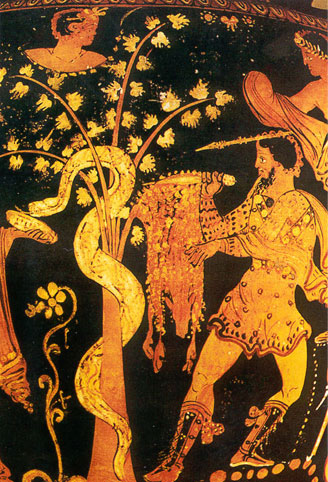
According to the legend, a Greek prince named Jason was charged with the task of finding and returning to Greece the golden fleece, which came from the skin of a golden ram. When the ram was sacrificed its skin was hung in a forest, guarded by a dragon that never slept.

Jason departed in a ship called Argos, the first warship ever built. After many adventures, Jason and his men reached Colchis, a land on the eastern shore of the Black Sea. The king of the place forced Jason to perform a series of tests.

One of these tests was to put the plow yoke on a pair of bulls exhaling fire. After successfully performing his test, Jason planted a field with the teeth of a dragon, from which armed men were born. Then, aided by the sorceress Medea, Jason managed to take the golden fleece and return to Greece.

This story was well known before the Greek poet Homer was born. For a long time it was considered a mere legend. But a few years ago, a stone with the inscription of an ancient period was found in Maikop, Russia, in what was once the Colchis. The stone tells a possible version of Jason's story. It speaks of a trip to the region by a group of Greeks during a previous period.

The legend of Jason and the Argonauts is now believed to represent a true journey by ancient Greeks to the shores of the Black Sea. The golden fleece that Jason and his men were looking for perhaps represented the gold that abounded in the ancient land of Colchis.

.

What is a ghost?

    A ghost is the apparition of a disembodied spirit. From earliest times the belief has prevailed that the souls of the dead return to haunt the scenes of their earthly existence. It is commonly believed that the vision of a ghost forebodes death or disaster, though specters may also be beneficent, as the ancestral ghosts of European legend, who warn their descendants of approaching danger or who counsel them in critical moments of their life. The traditional, ghost, whether malevolent or benign, bears the same appearance that it did in life, but it is luminous and transparent, and is commonly clothed in a shroud. Ghosts of murderers and other criminals appear bearing the instruments of their crime; they "haunt the scene of their crime," as the saying goes, and not uncommonly are accompanied by their victims.
    In spite of the great age of ghostly legend, the range of behavior of ghosts is relatively limited. They soar over graveyards, roam through ruined castles and deserted houses, turn over tables, and other furniture, and produce knocking noises, moans, groans, wails, and "eldritch shrieks." Rarely they are represented as wreaking physical violence upon human beings. More significant than these perfunctory activities attributed to them in legend is their function as mediators or counselors. Because ghosts are supposed to have access to superhuman power and wisdom, the curious and inquisitive of all ages have sought to conjure them, usually through the aid of a "medium," a person peculiarly fitted to communicate with the spirit world. The medium's power consists of an extreme psychic sensitivity, and this faculty is common to the shamans, witch doctors, and medicine men of primitive society, the sibyls of classical antiquity, the seers and necromancers of the Middle Ages, and the mediums and clairvoyants of modern occultism.
    In America, in 1850, the curious demonstrations of the Fox sisters awakened new interest in the subject of ghosts and apparitions, though in their demonstrations the ghostly manifestation consisted only of mysterious knockings. As the vogue for consulting spirits grew, the movement took on a religious character, and in 1863 a Spiritualist church was founded. The London Society for Psychical Research, founded in 1882, devoted itself to scientific investigation of ghostly phenomena produced during spiritualistic seances.

Hecate (myth)

   Hecate is a mythological Greek goddess, daughter of the Titan Perseus. Her powers extended into heaven, earth, and the lower world. Hecate was identified with Selene, Artemis, Persephone; is represented as having three bodies or three heads.


What does Cornucopia mean?

   Cornucopia was the horn of plenty, a symbol of abundance. In Greek legend the cornucopia was a horn of the goat Amalthea, which fed the infant Zeus. It was always full of whatever food or drink its possessor wished. According to the Romans the horn had been torn by Hercules from the head of the river-god Achelous, who turned himself into a bull to fight Hercules. This horn was always filled with fruit and flowers. Several Roman divinities had the cornucopia as an emblem. They included Flora, the goddess of flowers and spring; Concordia, the goddess of peace and harmony; and Plutus, the god of wealth.

Cupid legend

   In Roman mythology, Cupid is the god of love and son of Venus. He is identified with the Greek god Eros. In some accounts, Cupid is a handsome youth, while other sources describe him as a mischievous child. He is often represented as a winged archer and sometimes as blindfolded to signify that love is blind. Gods or mortals wounded by his arrows fell helplessly in love, as, for example, Apollo with Daphne, and Dido with Aeneas.
   The most famous legend about Cupid is probably the Cupid and Psyche myth narrated in Apuleius' The Golden Ass (2d century A.D.). According to this tale, Venus commanded Cupid to punish a mortal princess, Psyche, because she was so beautiful that men honored her instead of the goddess. However, when Cupid saw Psyche, he fell in love with her. He then made himself invisible and ordered her never to try to see him. When Psyche eventually disobeyed him, he left
her in anger. After much suffering and searching for him, Psyche was forgiven, granted immortality by Jupiter, and united with Cupid forever. This myth symbolizes the union of Love and Soul, for Cupid is the god of love and psyche is the Greek word for "soul."

Cyclops (myth)

   Cyclops, in Greek mythology, a one-eyed giant. According to Homer's Odyssey the Cyclopes were shepherds of Sicily. Savage and cannibalistic, they devoured all who came to their land. When one of them, Polyphemus, was bunded by the crafty Odysseus, he begged his father, the sea-god Poseidon, for revenge. Poseidon then became Odysseus' enemy and tried to prevent his return home after the Trojan War.
   Another tradition tells of three Cyclopes, the children of Uranus (Heaven) and Gaea (Earth), who were named Brontes, Steropes, and Arges. They assisted Zeus in his struggle against his father, Cronus, and gave him the thunderbolt as a weapon. However, when Zeus used a thunderbolt to kill Apollo's son Asclepius, Apollo killed the Cyclopes. According to still later myths the Cyclopes were the assistants of the fire god Hephaestus at his forges under Mount Etna in Sicily.

Deucalion (mythology)

   Deucalion, in Greek mythology, an ancient Greek king, the son of Prometheus and Clymene and the husband of Pyrrha. When Zeus, angered by the wickedness of all men, determined to destroy them with a flood, Prometheus advised Deucalion and Pyrrha to build an ark. During the flood the couple took shelter in the ark and were the only mortals to survive. After the flood subsided, they were advised by Themis, the goddess of justice, to renew the human race by casting behind them the bones of their mother. When Deucalion realized that these bones were the stones of Gaea (earth), the mother of all men, he and Pyrrha obeyed. The stones cast by Deucalion turned into men, and those thrown by Pyrrha became women. Deucalion and Pyrrha were the parents of Hellen, who gave his name to the ancient Greeks, or Hellenes. According to legend, Deucalion was the first King of the Hellenes.

Hades (mythology)

   The people of ancient Greece thought that the earth was flat. Down below it, they believed, there was a great, gloomy region to which people went when they died. This underworld the Greeks called Hades after the name of the god who ruled it. Pluto was another name for this god of the underworld.
   In Hades there was supposed to be a wide river—the Styx. The spirits of the dead had to cross the River Styx to enter Hades. On the bank of the river an old boatman, Charon, was always waiting to row them across. A huge dog with many heads stood guard at the gate of Hades to keep anyone who entered the underworld from escaping. The name of this dog was Cerberus.

Who were the Gorgones?

   In Greek myth, the Gorgones or Gorgons were three female monsters. Homer mentions only one, a frightful creature dwelling in Hades; but Hesiod speaks of three—Stheno, Euryale, and Medusa—dwelling in the western ocean, though later legends placed them in Libya. They are described as encircled with snakes, winged, and with brazen claws and huge teeth. Medusa, the only mortal sister, was at first a beautiful maiden; but Athena changed her hair into serpents and her aspect became so fearful that all who beheld her were turned into stone.

Leda (mythology)

Leda and the swan

   In Greek mythology, Leda was the wife of Tyndareus, king of Sparta. Zeus fell in love with Leda and used to visit her, disguised as a swan. Leda was the mother of Castor, Pollux, Helen of Troy, and Clytemnestra. She is represented in art with a swan by her side.

Who was Hector? (mythology)

   Hector is a character in Homer's Iliad; leader of the army of Troy in the Trojan War famed for valor. The eldest son of Priam ant Hecuba; husband of Andromache; father of Astyanax. Hector was killed by Achilles in revenge for his slaying of Patroclus; his body was dragged three times around the walls of Troy.

The Fates

   In Greek and Roman mythology, the Fates were the three sisters who controlled man's destiny. They were the daughters of Jupiter. Clotho spun the thread of life, Lachesis assigned to man his destiny, and Atropos cut the thread of life with her fatal scissors. In Scandinavian mythology the goddesses of fate, usually three, were called Norns.

Who untied the Gordian knot?

Who untied the Gordian knot?

    The Gordian knot was a famous knot in Greek mythology. The Phrygians, having elected as king a peasant named Gordius, he dedicated his car and yoke to Zeus, in the acropolis of GORDIUM, and tied the knot of the yoke in so skilful a manner that an oracle declared whoever should unloose it would be ruler of all Asia. When ALEXANDER THE GREAT came to Gordium he cut the knot in two with his sword, and applied the prophecy to himself.

Roc (bird)

   The roc or rukh was a legendary bird of gigantic size, known from the stories in the book of the Arabian Nights. The roc resembled an eagle, but was by far greater in size. It was large enough to seize an elephant in its talons. In the Arabian Nights, Sinbad the Sailor tells of seeing the roc's egg, which was fifty paces in circumference. The roc was assumed to live on the island of Madagascar. Marco Polo heard the people of the island report that at a certain season of the year the roc appeared from the south.


What is a Hyperborean?

   In Greek mythology, Hyperborean was one who lived beyond Boreas, or the North Wind. According to Greek legend, the Hyperboreans lived so far north that they were beyond the cold winds of winter and enjoyed a fruitful land of perpetual sunshine. They were free from care, disease, and war. Life lasted for 1,000 years, and was spent in constant enjoyment and the worship of Apollo. After the age of legend passed away the Greeks gave the name to the barbarians living north of them. In modern usage, the term is equivalent to Arctic. The Eskimos, for instance, are spoken of as a hyperborean race.

Furies (Roman mythology)

   Furies, in Roman mythology, were three goddesses of the underworld. To the Greeks they were known as Erinyes. Their names were Alecto, Tisiphone, and Megaera, and they served as attendants to Proserpina, the queen of the underworld. The Furies heard complaints against people who had committed such offenses as rudeness of the young to the aged, of children to parents, and of hosts to guests. They punished the offenders by driving them without rest from city to city and from country to country. Many of their victims died in agony. The Furies were born from the blood of Uranus after he had been wounded by his son Cronos. Their heads were like dogs' heads, w
ith bloodshot eyes. They had snakes for hair and wings like those of bats.

Myths and legends

   Before the days of science people in many different parts of the world made up stories to explain the world as they saw it. They told stories to explain why the seasons change, why birds migrate, why robins have red breasts, why each group of stars is in the sky, and many, many other such things. Stories of this kind are called myths. They are not true. But they show that the people who made them up were really trying to understand the world around them.

   There are many Indian myths about nature. The next is a myth told by the Ojibway Indians. Ojeeb Annung, so the myth says, was a famous hunter. He had the power of changing himself into a fisher, an animal of the forest, whenever he wished.

   The hunter's son also wanted to be a great hunter, but the land where he lived was too cold much of the time. The boy's hands were so cold that he could not fit his arrows into his bow. He begged his father to make summer come. His father promised, although he knew it would be hard.

Minotaur

   Minotaur, Greek mythol­ogy, a monster represented as having the body of a man and the head of a bull. The name means bull of Minos. The bull was confined in the Cretan labyrinth by Minos, king of Crete, and fed on human flesh. Seven youths and seven maidens of Athens were thus sacrificed yearly until Theseus, with the aid of Ariadne, daughter of Minos, succeeded in slaying the monster.


Hymen (mythology)

   Hymen was at first the name of a marriage song among the Greeks. Later it became the name of the god of marriage. Hymen was supposed to be the son of Apollo and one of the Muses. Wedding guests made sacrifices to him for the happiness of the bride and groom. Hymen is pictured as a youth carrying a torch.

The Valkyries

   Valkyries, in northern mythology, the daughters or attendants of Odin, goddesses of fate. Clad in full armor and on horse-back, they rode through the air to the scene of battle to determine its course and to choose for Odin heroes worthy of Valhall. Die Walküre, which had its premiere in Munich, 1870, was composed by Richard Wagner as the second opera of his Ring of the Nibelungen. It has as its theme the disobedience of Brünnhilde, one of the maidens of death.