Showing posts with label Solar System. Show all posts

Is the Sun yellow or white?

Is the Sun yellow or white? sunset

 Throughout the day we observe that our star changes tonalities: yellow at dawn, white at noon and red at dusk. Why?

This happens when the light of the Sun penetrates the atmosphere, the blue color tends to be dissipated, but not the red and yellow, so we see our star with those tonalities: from the characteristic yellow at dawn, to the strong red at dusk.

The color of a star, on the other hand, depends on its age and size: there are red giants or white dwarfs, for example our Sun, is actually white. Moreover, human sight is not able to distinguish colors in the dark, for this reason we see all white stars at night, except Betelgeuse in the constellation of Orion and Antares in Scorpio, which because they are at the end of their lives, look indistinguishably red if compared to other stars. If the Sun were one of those distant stars, we would see it as a white rather than a yellow star.

.

Comets

   The Sun has a whole family of heavenly bodies traveling around it. Some of the most interesting are the comets. "Comet" comes from a Latin word that means "hair." A comet looks like a star that has shining hair streaming out from it.
   There are hundreds of comets in our solar system, but many people have never seen one. Most comets do not come close enough to the Earth to be seen without a telescope.
   People of long ago were very much frightened when there was a comet bright enough to be seen. They thought it was a sign that something terrible was about to happen. Today people have given up that old idea.
    Comets have paths around the Sun just as the Earth has. But their paths differ in shape. They are like a long oval. The paths of many comets cross the Earth's path. Some day the Earth may have a head-on collision with a comet. It has already gone through the tail of one. This happened on May 18, 1910. Newspapers carried the news in advance. Many people feared the world would end. But nothing happened at all. If the news had not been in the papers, few people would have known that the Earth had had a strange adventure.
   No one knows what would happen if the Earth ran into the head of a comet. The head of a comet is very big, but it is not a solid ball. Scientists believe it is made up of millions of chunks of rock and iron surrounded by gas. Possibly the Earth would be badly damaged if it did hit the head of a comet.
   When a comet is far away from the Sun, it does not have a tail. But when a comet comes close to the Sun, the light of the Sun drives out some of the gas in the head. This forms a tail which shines in the sunlight. A comet's tail always streams out away from the Sun.
   Halley's comet is the most famous comet. It was named for Edmund Halley, a famous English astronomer. Halley's comet comes close to the Earth every 76 years. It was through the tail of this comet that the Earth passed in 1910. This same comet was seen during the Crusades when the Christians were fighting the Turks. One of the Christians' prayers was "Lord, save us from the Devil, the Turk, and the Comet."
   Sometimes a comet goes too close to the Sun or a large planet and is pulled to pieces. Nothing is left of it but bits of rock and iron. All the comets may finally be destroyed.

Are comets permanent members of our solar system?

   There are many theories as to what happens at the end of a comet's life. The most common is that the comet's nucleus either splits or explodes, which may produce a meteor shower. It has also been proposed that comets eventually become inactive and end up as asteroids. Yet another theory is that gravity or some other disturbance causes a comet to exit the solar system and travel out into interstellar space.

Are comets the source of life on Earth?

   British astronomer Fred Hoyle (1915-2001), who served as a professor of astronomy and philosophy at the Institute for Theoretical Astronomy in Cambridge, England, has made detailed studies of the nu­clear reactions that take place in the core of a star. He has also researched the gravitational, electrical, and nuclear fields of stars and the various elements formed within them. Hoyle is the author of several books on stars, both technical and for general readers, as well as a number of science fĂ­ction stories and even a script for an opera. Hoyle believes that life on Earth began with organic compounds found in interstellar space that were carried to Earth by comets.

How do we know how far it is to the Moon?

   Long, long ago men watched the sky and tried to figure out ways of measuring the things they saw mere. How far was it to the Moon, for example? These ancient sky watchers were good at mathematics. They did some rather complicated figuring, and they decided that the Moon was about 240,000 miles away.
   Today sky watchers have a way of testing the figures for us. They do it with radar. They broadcast radio waves which travel to the Moon and then bounce back to earth. The radar measuring instruments tell how many seconds it takes the waves to make the round trip. Divide this by two and we know how many seconds it takes the waves just to go to the Moon. Since we know how fast radio waves travel, we have only to do some multiplying. We multiply the speed of the waves by the number of seconds it takes for them to reach the Moon. The answer is — about 240,000 miles. That's how far you will have to travel when you go by rocket to the Moon.

Transit of Venus

   Every One-hundred years or so, observers on Earth can watch Venus at inferior conjunction pass across the face of the Sun. These rare events are called transits of Venus, and they occur in a pair, 8 years apart. The last two transits were in 1874 and 1882; the next two take place on 8 June 2004 and 6 June 2012. In 2004, Venus crossed the southern part of the Sun, and in 2012, the northern part.
   In earlier times, transits of Venus let astronomers measure the distance from Earth to Venus, and, by extension, the scale of the Solar System. After the telescope was invented, a handful of astronomers made individual efforts for the 1639 transit. But for the 1761 and 1769 events, the British and French sent out expeditions all over the globe, among them the famous exploring voyage of James Cook, which went to Tahiti for the 1769 transit.
   Better distances for the Solar System did emerge from these efforts, but the most notable finding was about Venus itself. Observing the 1761 transit, the Russian scientist Mikhail Lomonosov discovered that Venus has an atmosphere. He noted the halo it produced around the black dot of the planet as it slipped onto the solar disk and off again.

transit of Venus

Transit of Venus in 2004

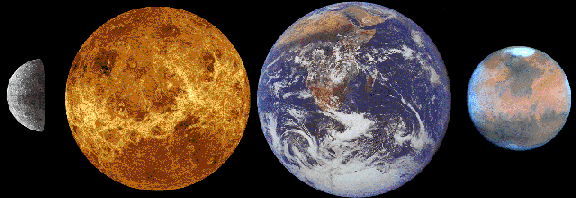
The inner planets

The four inner planets (Mercury, Venus, Earth and Mars) are the midgets of the solar system. All are quite dense and, apart from Earth, have barren, rocky surfaces. The features of Earth are softened by the great oceans that cover 71% of its surface.
Only the thinnest of atmospheres exist on Mercury and Mars. As a result there is a great difference between day and night-time temperatures. On Mercury the change can be as high as 400 °C. Earth and Venus, however, have shielding atmospheres. Their temperatures are fairly constant. On Earth at the equator, this is about 15 °C while most of Venus roasts at nearly 500 °C— hot enough to melt lead!

Orbiting in the 550 million km gap between Mars and Jupiter are tens of thousands of small rocky objects called asteroids. Ceres (recently named a dwarf planet) is the biggest, with only 950 km across—most are only house or boulder-sized.
Astronomers think that the asteroids are the building blocks of a planet which never formed.

Some facts about LUNAR ECLIPSES

  • A total eclipse of the Moon occurs when the Moon passes behind the Earth so that our planet blocks the Sun’s rays from striking the Moon.
  • The Lunar eclipses can only occur at full moon.
  • The next total lunar eclipse will occur on December 21, 2010.
  • Eclipses are visible from the Moon, too:
  • A lunar eclipse lasts for a few hours, whereas a total solar eclipse lasts for only a few minutes at any given place.
  • A partial lunar eclipse occurs when only a portion of the Moon enters the umbra.
  • The Chinese word for eclipse is chih, which means “to eat.”
  • If the Earth had no atmosphere, the Moon would be completely dark during an eclipse.
  • The maximum time a lunar eclipse can last is three hours and forty minutes.
  • A Solar eclipse always occurs 2 weeks before or after a lunar eclipse.
  • The longest time the Moon can stay in totality is 107 minutes.
  • Lunar eclipses can occur up to 3 times a year.
  • Lunar eclipses are visible over an entire hemisphere.
  • When Columbus and his men were stranded in Jamaica for 6 months, the natives refused to feed them, so Columbus, having read in his almanac that a lunar eclipse was about to occur, told them that God was angry and was going to obliterate the Moon. The natives freaked out and asked Columbus to intervene. He "talked" to God, the Moon came back and they were lavished with food.

Interesting facts about dwarf planets

  • A dwarf planet is a celestial body that orbits the Sun, too small to be considered a real planet but too large to be called a asteroid.
  • It has to have sufficient mass to overcome its compressive strength and achieve hydrostatic equilibrium.
  • The Solar System currently has 5 dwarf planets: Ceres, Pluto, Haumea, Makemake and Eris.
  • The term dwarf planet was adopted in 2006.
  • Ceres at first was classified as a large asteroid.
  • It is suspected that at least another 40 known objects in the Solar System are dwarf planets.
  • Pluto was first considered a small planet in itself.
  • For almost 50 years Pluto was thought to be larger than Mercury.
  • Eris was discovered in 2005 beyond the orbit of Pluto.

15 interesting facts about astronauts

  1. Astronauts grow taller (height) in space.
  2. The first woman in space was a Russian called Valentina Tereshkova.
  3. You have to be at least 58.5 inches tall to be an astronautastronaut in space
  4. Astronaut Neil Armstrong first stepped on the moon with his left foot
  5. The Apollo astronauts were not given life insurance before their flights
  6. Armstrong’s quote “That’s one small step for man, one giant leap for mankind” was said 6 1/2 hours after landing. Armstrong claimed he said “a man” which was inaudible due to static
  7. Neil Armstrong almost died during a training exercise while controlling the landing module

14 interesting facts about Solar eclipses

  1. There are at least 2 solar eclipses per year somewhere on Earth. The most times a solar eclipse can occur during a year is five.image solar eclipse
  2. It is safe to observe the total phase of a solar eclipse directly with the unaided eye, binoculars or a telescope, only when the Sun's photosphere is completely covered by the Moon. During this period the Sun is too dim to be seen through filters. The Sun's faint corona will be visible, and the chromosphere, solar prominences, and possibly even a solar flare may be seen. However, viewing the Sun after totality can be dangerous.
  3. A solar eclipse occurs when the moon passes between the Sun and the Earth so that the Sun is fully or partially covered.
  4. A total solar eclipse can only happen if the Moon covers more than 90% of the Sun.
  5. The longest duration of a solar eclipse is about 7.5 minutes. The maximum time a lunar eclipse can last is about 3.5 hours.
  6. Lunar eclipses are visible over an entire hemisphere. Solar eclipses, on the other hand, are visible only in a narrow patch of land about 167 miles wide.

18 interesting facts about the Sun

  1. Within the core of the Sun, the temperature (15,000,000 K) and pressure (340 billion times Earth's air pressure at sea level) of it is so intense that nuclear reactions actually take place.
  2. The Sun revolves around our galaxy (the Milky Way) every 225 – 250 million years (a galactic year).
  3. Containing more than 99.8% of the total mass of the Solar System, the Sun is by far the largest object in the Solar System.
  4. The Sun orbits the center of the Milky Way galaxy at a distance of approximately 26,000 light-years from the center of the galaxy.
  5. 109 Earths would be required to even fit across the Sun's disk, and the Sun's interior could hold over 1.3 million Earths.
  6. The Sun is not a solid body, as many people think. It has different regions, which rotate at different speeds. The equator region completes a rotation in about 27 days, but the polar regions take about 30 days.
  7. The Sun's energy output, produced by these nuclear fusion reactions, is approximately 3.86e33 ergs/second or 386 billion billion megawatts.
  8. The Sun is just another of billions of stars out there. Despite its huge size, it’s tiny: there are many other stars out there that are hundreds of times as large as the Sun.
  9. The process that takes this energy to the surface of the sun following complex stages is called convection.
  10. As the Sun grows older, it gets brighter and hotter. Over the next few billion years, the Sun will heat up so much that all the heat will burn away life on Earth. But that’s only going to happen after a few billion years.
  11. This energy, released as heat as well as light, takes a million years to reach the surface.
  12. The Sun is very wide. It has a diameter of about 1.4 million kilometers. To put that in perspective: the Earth has a diameter of about 13 thousand kilometers. It would take more than a 100 Earths to span the entire width of the Sun!
  13. The Sun also emits low density streams of particles, also known as the solar wind. These winds blow through the solar system at 450 km/sec and consist mostly of electrons and protons.
  14. The Sun is 93 million miles away from the Earth. Light from the Sun takes just over 8 minutes to arrive at Earth. It’s interesting to note, therefore, that if the Sun suddenly stopped shining altogether, it would take us about 8 minutes to realize that.
  15. The Sun consists of the core, photosphere, chromosphere and corona, each with differing temperatures and components.
  16. Existing for about 4 and a half billion years, it has burnt up about half of the hydrogen in its core. This leaves the Sun's life expectancy to 5 billion more years, at which time, the Sun's elements will "swell" up, swallow Earth, and eventually die off into a small white dwarf.
  17. The Sun has structure. It is not simply a huge ball of fire. The surface of the sun is called the photosphere, and is dense with gases. Under the photosphere lies the convective zone, where heat moves to the surface (thus the name : convective), and cooler material falls back down. This layer makes up roughly 70% of the Sun’s radius. Now that’s big. Then comes the radiative zone, where heat is radiated up towards the surface. Then comes the core, where temperatures can easily be around 15,000,000 °C. This is where hydrogen and helium molecules are fused together, to create the light we see.
  18. The Sun makes up about 99.8% of the weight of our entire solar system. Its mass is about 2 x 1027 tonnes, and is more than 300,000 times heavier than the Earth.

9 interesting facts about Asteroids

  1. Asteroids can contain water, iron, silicates, and some heavy metals - like gold, lead, and uranium.
  2. The largest asteroid is Ceres, is about the size of Texas.
  3. Even if there are 1000 times more asteroids than we know of today, then on average each asteroid would have over one million km2 to itself.
  4. The vast majority of asteroids are grouped in the asteroid belt.
  5. Due to a relatively unknown NASA directive, 23% of all asteroids are named ‘Steve’.
  6. The best estimate is that there are 1,500-2,000 asteroids one and one-half mile in diameter or larger.
  7. The distinction between asteroids and comets is fuzzy—comets tend to have more chemical compounds that vaporize when heated, such as water, and more elliptical (egg-shaped) orbits than asteroids do.
  8. Most asteroids are covered in dust. This dust is called regolith.
  9. A group of asteroids orbit the sun called Near-Earth Asteroids because they are somewhat close to the Earth and occasionally may cross Earth’s orbit.

11 interesting facts about stars

interesting facts about stars
  1. The star that is nearest to Earth is the Sun.
  2. A star is a colossal, glowing ball of plasma.
  3. Stars are first formed as clouds of gas and dust. In fact, they basically comprise of hydrogen gas.
  4. Almost all elements that are heavier than hydrogen and helium were created inside the core of stars.
  5. Every star generates a stellar wind of particles that causes a continual outflow of gas into space.
  6. Stars spend about 90% of their lifetime fusing hydrogen, to produce helium in high-temperature, and in high-pressure reactions near the core.
  7. The oldest star yet discovered is HE 1523-0901, which is an estimated 13.2 billion years old.
  8. Most stars are between 1 billion and 10 billion years old.
  9. All the stars that make up Milky Way Galaxy revolve around the center of the galaxy once every 200 million years or so.
  10. Stars come in different colors. While hot stars give off blue light, cooler stars give off red light.
  11. Stars twinkle because the light we see coming from them travels through the atmosphere around the Earth and there is turbulence in the Earth's atmosphere.

15 interesting facts about Earth

earth planet facts
  • Earth is almost five billion years old, although life has only existed on the planet for the last 150 to 200 million years. This means that life has been present on the planet for only 5%-10% of its lifetime.
  • Earth is the only planet in the Solar System to have water in all its three states of matter: solid (ice), liquid (sea, rain, etc.) and gas (clouds).
  • The length of time it takes for Earth to orbit the Sun is 365 and a quarter days. To make up this extra quarter, which isn't counted at the end of a year, we have an extra day every four years i.e. on 29th February.
  • Earth and Mercury are the two densest planets in the Solar System.
  • Despite being called Earth, only 29% of the surface is actually 'earth' (land). The rest of the planet's surface (71%) is made up of water.
  • Earth is the only planet in the Solar System not to be named after a mythical God.
  • Earth is the only planet in the Solar System known to be geologically active
  • From a distance in space, Earth would seem to be the brightest of the 8 planets. This is because large amount of sunlight is reflected by the water on the planet.
  • Earth has a diameter of 12,760 km and mass of about 5.972 x 1024 kg
  • Earth's average distance from the Sun is 92,960,000 miles
  • Earth has only one satellite, the Moon. Moon is the second brightest object in the sky, as seen from the planet.
  • Earth is the fifth largest planet in the Solar System.
  • Earth, along with Mercury, is densest planet in the Solar System.
  • Earth's atmosphere is composed mainly of nitrogen (77%), oxygen (21%), argon (0.93%), and carbon dioxide (0.03%).
  • The average distance between Earth and Moon is 238,857 miles (384,403.1 km).

.

15 interesting facts about the Moon

moon facts

1. The diameter of the Moon is 2,160 miles (3,476 kilometers).
2. The average distance between Earth and its Moon is about 238,900 miles (384,000 kilometers).
3. The time taken by Moon to complete one rotation and one revolution is the same - about 27.3 days. This is why, from Earth, we always see the same side of the Moon.
4. The surface gravity of the Moon is only one-sixth that of Earth.
5. The Moon's gravitational pull on Earth is the reason behind the phenomenon of rise and fall of ocean tides.
6. There is no water and no air on Moon.
7. From earth, only 59 percent of Moon's surface is visible.
8. The Moon is the only extraterrestrial body to have been visited by humans. It is also the only body from which samples have been taken.
9. There is no global magnetic field on the Moon.
10. The first unmanned vehicle to orbit the Moon was sent in 1966, under the name Luna 10.
11. The surface of the Moon is covered with craters, basins, and cratered highlands, called terrae.
12. The soil that covers the Moon is composed of rock fragments and fine dust grains. It is known by the name of 'regolith'.
13. The total atmospheric mass of Moon is less than 104 kg.
14. Lunar eclipses occur near a full moon, when the Earth is between Sun and the Moon.
15. During its brightest phase i.e. at "full moon", the Moon has an apparent magnitude of about −12.6.

10 interesting facts about Pluto

pluto planet facts

 1. Pluto is named after Hades, the Greek God of the underworld. Pluto is the Roman translation.
2. Clyde Tombaugh discovered Pluto in 1930.
3. Pluto has a moon, Charon, about half the size of the planet. The Hubble Space Telescope, has found two more moons orbiting Pluto. Called Nix and Hydra, they are named after the Greek goddess of darkness (Nyx) and a nine-headed serpent that in Greek mythology guards the underworld.
4. Pluto orbits the Sun once ever 248 years.
5. Pluto is so far from the Sun, it takes sunlight over 5 hours to reach it. In contrast, sunlight reaches the Earth in 8 minutes.
6. Pluto is believed to have an average temperature of roughly -63 degrees Celsius.
7. Pluto is two-thirds the size of our Moon.
8. Pluto has an eccentric orbit, which means it is occasionally closer to the Sun than Neptune.
9. The first time we will visit Pluto for a significant orbital period is in 2015, when the probe New Horizons is scheduled to arrive. It was launched in January 2006.
10. One theory suggests Pluto is not a planet, but a twin moon to Triton. Triton is the moon orbiting Neptune and seems to have nearly the same characteristics of Pluto.

10 facts about the planet Neptune

neptune planet facts

 1. Neptune's moon, Triton has the coldest temperatures measured in the Solar System, about -230°c.

2. Neptune is the fourth largest planet among the eight main planets in our Solar System.

3. Neptune looks blue in color. This is due to the absorption of red light by methane in the atmosphere.

4. Neptune's atmospheric composition comprises of hydrogen, helium, methane, traces of ammonia and water.

5. In Roman Mythology, Neptune is the God of the Sea.

6. Amongst all the eight planets in the Solar System, Neptune has the strongest wind flow. The wind blows in a westerly direction, at a speed of 2,000 km/hour.

7. Like Jupiter's Great Red Spot, Neptune also has dark spots. However, these spots disappear and reappear on different parts of the planet, unlike Jupiter's spot.

8. Neptune's moon, Triton, is slowly getting closer to it. It is believed that finally, the moon will get so close that it will get torn apart by Neptune's gravity and, possibly, form rings more spectacular than Saturn's.

9. It takes 165 years for Neptune to revolve around the Sun. Since its discovery in 1846, the planet has not yet completed a full orbit.

10. Neptune's moon, Triton orbits in the direction opposite to the planet's rotation. It is the only large moon in the Solar System to do this.

9 Facts about the planet Uranus

uranus planet facts

 1. As per mythology, Uranus was the lord of the skies and husband of Earth. He was also the King of the Gods, until his son Saturn overthrew him.

2. Uranus has a pale blue color, which is caused by the methane in its atmosphere that filters out red light.

3. Sir William Herschel was the first person to discover Uranus, on March 13, 1781.

4. Like Saturn, Uranus also has rings. The rings are made of ice and small rock particles, which are so faint that they appear as black as charcoal.

5. Uranus orbits the Sun on its side. Its South Pole is pointed towards Earth. The angle of the tilt of its axis is 98 degrees.

6. A year on Uranus is equivalent to 84 Earth years.

7. Uranus has 21 moons. Five of these moons are large, while the rest are smaller.

8. The atmospheric composition of Uranus comprises of hydrogen, helium, and methane.

9. A day on Uranus is shorter than a day on Earth, at about 17 hours long.

12 facts about the planet Saturn

saturn planet facts

 1. Galileo was the first person to discover the Saturn rings. He was confused by its strange appearance in his telescope.

2. Saturn is the second largest planet in the solar system.

3. It was in 1659 that Christiaan Huygens rightly inferred the geometry of the rings.

4. Due to fast rotation on its axis, Saturn is flattened at the poles.

5. Saturn's distance from the Sun is two times that of Jupiter.

6. Saturn is the only planet in our solar system that is less dense that water.

7. Saturn’s rings are believed to be the particles of an old moon destroyed in a collision about 50 million years ago.

8. A Saturn year lasts for more than 29 Earth years, but a Saturn day only lasts 10 hours and 14 minutes.

9. Saturn is yellow in color and is believed to be the third brightest planet in night sky.

10. It is assumed that Saturn’s rings will disappear one day. They will either dissolve into space or get sucked into the planet by its pull of gravity.

11. Saturn was the god of agriculture in Roman mythology. Saturn is also the father of Jupiter, the king of the Roman gods.

12. Saturn has the most number of moons in our solar system.