Many legends are presented about the facts of famous historical figures, and these stories are often not true.
For example, the story of George Washington cutting the cherry tree or throwing a silver dollar across the Potomac River are both legends, and the events they describe probably never happened.
But most of the legends about Benjamin Franklin are true. For example, it is true that Franklin proved that lightning is pure electricity, and that he invented the lightning rod. Franklin also invented bifocal eyeglasses, in which each lens contains one area for seeing things nearby and another area for seeing things far away.
Other inventions include a type of iron stove, now called the Franklin stove, and the Boston swing chair.
Franklin was the first person to write about the existence of an ocean current called the Gulf Stream. He also organized the first fire department in Philadelphia, the first lending library in the United States, and the first fire insurance company.
He helped create America's first hospital, also the first efficient postal system in the country, and a school that later became the University of Pennsylvania.
In 1785, Franklin's bifocal eyeglasses cost $100 a pair - not far from what they cost today!
.
Showing posts with label famous people. Show all posts
Which person spoke more languages?
A GREAT HYPERPOLYGLOT OF ITALIAN ORIGIN
A person who is fluent in one language can easily speak and write in that same language. Many people are fluent in ten or more languages, but very few have become fluent in more than 20.
Perhaps the greatest expert in learning languages in history was Giuseppi Caspar, who was born in Italy in the 18th century. Caspar was a carpenter, who later became a priest and then a cardinal, taking the name of Cardinal Mezzofanti.
No one knows for sure how many languages Cardinal Mezzofanti could speak, but there were probably more than 30. Some think he could speak 53 languages perfectly, and that he could understand most of what was spoken in more than 100 different languages.
The language that gave him the most work was Chinese - it took four months to learn it!
Although Mezzofanti could speak the languages of dozens of nations, he never set foot outside Italy in his entire life.
.
A person who is fluent in one language can easily speak and write in that same language. Many people are fluent in ten or more languages, but very few have become fluent in more than 20.
Perhaps the greatest expert in learning languages in history was Giuseppi Caspar, who was born in Italy in the 18th century. Caspar was a carpenter, who later became a priest and then a cardinal, taking the name of Cardinal Mezzofanti.
No one knows for sure how many languages Cardinal Mezzofanti could speak, but there were probably more than 30. Some think he could speak 53 languages perfectly, and that he could understand most of what was spoken in more than 100 different languages.
The language that gave him the most work was Chinese - it took four months to learn it!
Although Mezzofanti could speak the languages of dozens of nations, he never set foot outside Italy in his entire life.
.
What is the relationship between dynamite and Nobel Prizes?
Alfred Nobel was a Swedish chemist and engineer whose family owned an explosives factory. When Alfred's brother died from an explosion at the plant, the chemist became obsessed with finding a way to make explosives safer to handle.
Nitroglycerin was a general-purpose explosive then, but it is so unstable that it can explode when simply shaken. Nobel found that nitroglycerin can be much more stable - and safely handled - if it was soaked inside, or mixed with certain absorbent substances such as wood pulp or sawdust.
In 1867, he was granted a patent for his new explosive, which he called dynamite, from the Greek word meaning "potency.
When the Swedish chemist died in 1896, he provided in his will that his fortune should be used to establish five annual prizes in the achievements of medicine, physics, chemistry, literature and peace. These awards, called Nobel Prizes, are still presented each year. A sixth distinction, in economics, was added in 1969.
.
Nitroglycerin was a general-purpose explosive then, but it is so unstable that it can explode when simply shaken. Nobel found that nitroglycerin can be much more stable - and safely handled - if it was soaked inside, or mixed with certain absorbent substances such as wood pulp or sawdust.
In 1867, he was granted a patent for his new explosive, which he called dynamite, from the Greek word meaning "potency.
When the Swedish chemist died in 1896, he provided in his will that his fortune should be used to establish five annual prizes in the achievements of medicine, physics, chemistry, literature and peace. These awards, called Nobel Prizes, are still presented each year. A sixth distinction, in economics, was added in 1969.
.
What was the cause of Mozart's death?
On December 5, 1791, the world of music lost Wolgang Amadeus Mozart. The mystery of his death was never clarified, and several hypotheses were woven into it. The diagnosis issued by the doctor who certified the death was laconic and imprecise: Hitzigas Friesel Fieber (Death by high fever). Clinically, this is a diagnosis that doesn't explain anything... mysteriously, nobody cared to clarify it. Enigmatic, extremely enigmatic. Among numerous theories, they stand out:
Number One Theory:
Mozart died of "rheumatic fever". According to his medical history, it may be the real cause of his death. The Wochembla magazine in Berlin published on December 12, 1791 a laconic note asserting that Mozart's body was inflamed, a symptom of that disease.
Theory Number Two:
Mozart died poisoned by Antonio Salieri, composer and opera director of the Court of Emperor Joseph II, who was attributed with incurable envy against the musician. Various investigations have shown that this theory is apparently absurd.
Theory Number Three:
Mozart was poisoned with "tofana water" by a Mason brother, member of the Court of Emperor Joseph II. "Tofana water" was a mixture of water and arsenic, of delayed action, widely used in the eighteenth century for criminal purposes. Franz Hofdemel, the member of the court, was married to Magdalena Hofdemel, an outstanding pianist in Vienna and a student of Mozart. Believing that his wife was in love with Mozart, Hofdemel tried to murder Magdalena (disfigured her face), poisoned the musician, and then committed suicide. This theory, like so many others, lacks more concrete and proven data.
Theory Number Four:
Mozart was assassinated by the repressive apparatus of Emperor Joseph II and later buried in a mass grave, without identification. There were those who affirmed that Mozart's great operatic successes reflected revolutionary ideas, sowing the fear that they could provoke great changes in the political and social order of the time. Another absurd theory, according to several researchers.
But there are several questions regarding Mozart's death that can never be answered... of facts that are true and produce infinite doubts: Why the speed in burying Mozart's body? Why didn't anyone mark the burial site? Why were funerals performed with mysterious haste?
.
Number One Theory:
Mozart died of "rheumatic fever". According to his medical history, it may be the real cause of his death. The Wochembla magazine in Berlin published on December 12, 1791 a laconic note asserting that Mozart's body was inflamed, a symptom of that disease.
Theory Number Two:
Mozart died poisoned by Antonio Salieri, composer and opera director of the Court of Emperor Joseph II, who was attributed with incurable envy against the musician. Various investigations have shown that this theory is apparently absurd.
Theory Number Three:
Mozart was poisoned with "tofana water" by a Mason brother, member of the Court of Emperor Joseph II. "Tofana water" was a mixture of water and arsenic, of delayed action, widely used in the eighteenth century for criminal purposes. Franz Hofdemel, the member of the court, was married to Magdalena Hofdemel, an outstanding pianist in Vienna and a student of Mozart. Believing that his wife was in love with Mozart, Hofdemel tried to murder Magdalena (disfigured her face), poisoned the musician, and then committed suicide. This theory, like so many others, lacks more concrete and proven data.
Theory Number Four:
Mozart was assassinated by the repressive apparatus of Emperor Joseph II and later buried in a mass grave, without identification. There were those who affirmed that Mozart's great operatic successes reflected revolutionary ideas, sowing the fear that they could provoke great changes in the political and social order of the time. Another absurd theory, according to several researchers.
But there are several questions regarding Mozart's death that can never be answered... of facts that are true and produce infinite doubts: Why the speed in burying Mozart's body? Why didn't anyone mark the burial site? Why were funerals performed with mysterious haste?
.
Who was Elizabeth Bathory, the bloody Countess?
Elizabeth Báthory was a 17th century Hungarian countess, wife of General Ferenz Nadasdy. She lived in the castle of Csejthe in the Carpathian region.During the absences of her husband (who traveled to participate in military campaigns), she organized meetings with magic practitioners, who convinced her that she would remain beautiful if she bathed in the blood of maidens. In this way, her servants went out at night to hunt young peasants who were then sacrificed. It is estimated that there were more than 600 victims.
Elizabeth Bathory was tried in 1610. Her accomplices were beheaded or burned at the stake. She was sandwiched in a small room in the castle and died there four years later. There is a book about her fascinating life, The Bloody Countess, by Valentine Penrose.
.
Facts about Ernesto "Che" Guevara
Ernesto "Che" Guevara had Irish ancestry from his father.
Che Guevara was nicknamed 'chancho' (pig) when he was very young because of his sporadic visits to the shower. His habit of wearing a clean shirt every week was also well known.
Che Guevara liked to play chess and read poetry fervently. In school his favorite subjects were math and engineering.
When Che was born, his father, Ernesto Guevara Lynch, said: "The first thing to notice is that in my son's veins runs the blood of the Irish rebels.
Che Guevara was a doctor by profession.
In 1964, Che Guevara traveled to the United Nations building in New York to condemn U.S. racial policy.
Che Guevara had 5 children, a daughter with his first wife, Hilda Gadea, and the other four children with his second wife, the revolutionary Aleida March.
After his execution in Bolivia, a doctor amputated Che's hands, which were sent to Buenos Aires to have his fingerprints identified.
The famous photograph of Che Guevara, which has become a world icon, was taken by the photographer Alberto Korda.
In Bolivia, some people consider Che Guevara as ''San Ernesto'', who is venerated as a saint. This practice is obviously not approved by the Catholic Church.
.
Great facts about people who made History
SOME CURIOUS FACTS ABOUT PEOPLE WHO MADE HISTORY
Charles Dickens used to sleep facing north. He thought this would help him write better.
The three best-known Western names in China: Jesus Christ, Richard Nixon and Elvis Presley.
Julius Caesar carried a laurel on his head to cover the beginnings of baldness.
The house where Jefferson wrote the declaration of Independence from the United States was replaced by a hamburger place.
The inventor of dynamite, Alfred Nobel, did not want to be remembered as a propagator of violence; and as a way to amend this, he laid in his will the foundations of what we know today as the Nobel Prizes.
Mao Zedong, the first supreme leader of the Chinese Communist Party, held the position of Assistant Librarian at Peking University before coming to power in China.
During the First World War, the future Pope John XXIII was a sergeant in the Italian army.
Albert Einstein was offered the presidency of Israel, but he declined saying he had no head for problems.
When Albert Einstein died he said a few last words, unfortunately the nurse next to him did not understand German.
Catherine I of Russia made a law prohibiting a man from getting drunk before nine o'clock at his parties.
During the reign of Elizabeth I of England, a tax was issued to tax men who wore beards.
One of the gifts Queen Victoria received in her marriage was a cheese 3 meters in diameter and half a ton of weight.
Sir Isaac Newton was deeply obsessed with the occult and the supernatural.
Marie Curie, who twice won the Nobel Prize, and discovered the radio element, could not be accepted as a member of the prestigious French Academy because she was a woman.
John D. Rockefeller donated more than $500 million during his lifetime.
John Paul Getty, once the richest man in the world, has a coin phone in his mansion.
Sir Winston Churchill 'limited' himself to smoking only 15 cigars a day.
Lady Astor once told Winston Churchill 'if you were my husband, I would put poison in your coffee'. To which he replied ... If you were my wife, I would drink it!'.
The national flag of Italy was designed by Napoleon Bonaparte himself.
George Washington's birthday is the only official birthday celebration in the United States.
While studying at Harvard University, Edward Kennedy was suspended for cheating on the Spanish exam.
King Solomon of Israel had 700 wives and 300 concubines.
Queen Anne of England (1665-1714) survived all her 17 children.
In 1944, the young Fidel Castro was chosen as the best school athlete in Cuba.
Wolgang Amadeus Mozart never went to school.
.
Charles Dickens used to sleep facing north. He thought this would help him write better.
The three best-known Western names in China: Jesus Christ, Richard Nixon and Elvis Presley.
Julius Caesar carried a laurel on his head to cover the beginnings of baldness.
The house where Jefferson wrote the declaration of Independence from the United States was replaced by a hamburger place.
The inventor of dynamite, Alfred Nobel, did not want to be remembered as a propagator of violence; and as a way to amend this, he laid in his will the foundations of what we know today as the Nobel Prizes.
Mao Zedong, the first supreme leader of the Chinese Communist Party, held the position of Assistant Librarian at Peking University before coming to power in China.
During the First World War, the future Pope John XXIII was a sergeant in the Italian army.
Albert Einstein was offered the presidency of Israel, but he declined saying he had no head for problems.
When Albert Einstein died he said a few last words, unfortunately the nurse next to him did not understand German.
Catherine I of Russia made a law prohibiting a man from getting drunk before nine o'clock at his parties.
During the reign of Elizabeth I of England, a tax was issued to tax men who wore beards.
One of the gifts Queen Victoria received in her marriage was a cheese 3 meters in diameter and half a ton of weight.
Sir Isaac Newton was deeply obsessed with the occult and the supernatural.
Marie Curie, who twice won the Nobel Prize, and discovered the radio element, could not be accepted as a member of the prestigious French Academy because she was a woman.
John D. Rockefeller donated more than $500 million during his lifetime.
John Paul Getty, once the richest man in the world, has a coin phone in his mansion.
Sir Winston Churchill 'limited' himself to smoking only 15 cigars a day.
Lady Astor once told Winston Churchill 'if you were my husband, I would put poison in your coffee'. To which he replied ... If you were my wife, I would drink it!'.
The national flag of Italy was designed by Napoleon Bonaparte himself.
George Washington's birthday is the only official birthday celebration in the United States.
While studying at Harvard University, Edward Kennedy was suspended for cheating on the Spanish exam.
King Solomon of Israel had 700 wives and 300 concubines.
Queen Anne of England (1665-1714) survived all her 17 children.
In 1944, the young Fidel Castro was chosen as the best school athlete in Cuba.
Wolgang Amadeus Mozart never went to school.
.
Facts about Napoleon Bonaparte
Napoleone di Buonaparte was the name under which Napoleon Bonaparte was born on 15 August 1769 on the island of Corsica.Just one year before Napoleon's birth, the island of Corsica was part of Italy.
When Napoleon was first exiled to the island of Elba, he was granted sovereignty of the place.
As a brilliant military commander, Napoleon often defeated military forces larger than his own in size.
Napoleon upheld many of the French Revolution's principles of equality, including equality before the law and freedom of religion.
Napoleon created satellite kingdoms in Holland, Italy, Germany, and Spain where he placed his brothers and other relatives as monarchic rulers.
In his enthronement as emperor, instead of waiting for the Pope to place the crown on his head, Napoleon stepped forward and placed it on himself.
Napoleon Bonaparte had an irrational fear of cats.
Napoleonic troops often complained of the lack of supplies in prolonged military campaigns, so Napoleon asked the inventors of his time for a way to preserve food longer. It was Francois Appert, who came up with the idea of canned food.
On the wedding night, the cries and gasps of both Napoleon and Josephine frightened Josephine's dog, which, believing that Napoleon was harming his mistress, lunged at him and bit him.
Napoleon's star sign was Leo.
Napoleon imposed the cultivation of beet in France to produce sugar, as it could not receive the product of sugar cane, after having blocked the Corsican to Great Britain.
During Napoleon's invasion of Egypt, his troops bombarded the Sphinx, from which his nose was mutilated.
In 1808, Napoleon Bonaparte invaded Spain proclaiming his brother Joseph as king of this country.
In 1812, Napoleon invaded Russia, but had to withdraw after losing four-fifths of his troops.
On June 8, 1815, his final defeat occurred at the Battle of Waterloo.
A few days after the Battle of Waterloo, Napoleon was banished to the island of St. Helena, where he would die in 1821.
.
Great facts about Mother Teresa
Mother Teresa was born in Skopje, Albania on August 26, 1910.Mother Teresa of Calcutta's real name was Agnes Gonxha Bojaxhiu. Her father's name was Nikola and her mother's name was Dranafile.
Agnes' family was economically prosperous and characterized by helping the poor. Her father is thought to have been poisoned because of his political views when she was only 9 years old.
In 1928, at the age of 18, the young woman who would become Mother Teresa joined the missionary sisters of Loreto in Ireland. That same year she would embark to India where the young nun would be moved by the vision of terrible misery.
Mother Teresa of Calcutta made India her home for the last sixty-nine years of her life, and it is precisely in Calcutta that the Mother had the Seat of the Missionaries of Charity.
Mother Teresa spoke five languages: --English, Albanian, Serbo-Croatian, Bengali and Hindi.
In her youth Mother Teresa taught catechism at home, had published articles in a local newspaper and wrote poems.
Mother Teresa, besides advocating for the poor, was a great fighter against abortion.
Mother Teresa was diagnosed with heart problems in 1974, which she kept as secretive as possible because she did not want anything to get in the way of her continued hard work on behalf of the poor.
Mother Teresa was awarded the Nobel Peace Prize in 1979.
Pope John Paul II visited the "House of the Immaculate Heart" in Calcutta on February 4, 1986. Something that filled Mother Teresa with emotion.
At the time of Mother Teresa's death, her missionaries of charity worked in 123 countries.
Mother Teresa of Calcutta died in September 1997 at the age of 87.
In 2003 she was beatified by Pope John Paul II.
.
Great facts about Princess Diana of Wales
Diana was born into an aristocratic family in Park House, Sandringham, Norfolk England.Diana was the youngest daughter of Edward and Frances Spencer.
Diana's brothers are Sara, Jane, John (deceased) and Charles.
After a difficult divorce Diana's father got custody of her and her brother.
Diana's stepmother, Raine, was the daughter of the famed novelist, Barbara Cartland.
Some of Diana's cousins are: Oliver Platt, Audrey Hepburn, Humphrey Bogart, and Rainier III
Diana's ancestors include: Mary, Queen of Scotland, Lady Catherine Grey, Mary Boleyn, and Robert I
Lady Diana and Prince Charles engaged in marriage on February 24, 1981.
On July 29, 1981, Diana and Prince Charles were married at a wedding that was broadcast to much of the world.
Eleven years later, on December 9, 1992, Diana and Carlos separated from each other, a situation that lasted until the official divorce on August 28, 1996.
After her divorce, Diana gave herself to humanitarian work for the Red Cross, becoming a great activist around the world against landmines.
Diana's famous friends included Gianni Versace, George Michael, Michael Barrymore and Elton John.
Princess Diana greatly admired other women such as Mother Teresa, Madonna and Margaret Thatcher.
Diana was not wearing a seat belt when she died in a car accident inside the Pont D'Alma tunnel in Paris.
Diana's funeral, held on September 6, 1997, was televised to approximately 2.5 billion people in 60 countries around the world.
The image of Princess Diana has appeared on the cover of People magazine more than 50 times; 8 times in Time magazine; 7 times in Newsweek, and 12 times in Maclean's. All these publications are out of print.
.
Facts about Pope John Paul II
John Paul II, the first Slavic pope in history, was born on May 18, 1920 in the city of Wadowice, Poland.His real name was Karol Józef Wojtyła.
On October 16, 1978 he was elected pope, with the name of John Paul II.
The pontificate (26 years) of John Paul II was the third longest in the history of the papacy, after that of St. Peter (34 to 37 years) and that of Pius IX (31 years).
He was the first pope in 455 years not to be Italian.
John Paul II was the only pope whose life was portrayed in a comic book. In 1983 Marvel Comics published a biography of the pope.
He is the first pope since Pius II, in the 15th century, to be a "man of letters".
Before being ordained a priest, Karol Wojtyla was a member of an experimental theatre group, poet, stonemason and employee in a chemical factory.
In May 1981, John Paul II was shot by the Turk Mehmet Ali Agca in St. Peter's Square.
John Paul II was known as the 'traveling pope'. No other pope in history has traveled as extensively as he has. His word and presence has reached 117 countries around the world.
Pope John Paul II knew 8 languages. He learned Spanish after becoming a pope.
Time magazine named Pope John Paul II Man of the Year in 1994.
In his last years of life John Paul II suffered from Parkinson's disease.
During his pontificate John Paul II canonized 482 saints and beatified 1338 people, more than all his predecessors combined.
He traveled the equivalent of 30 times the circumference of the Earth, making 104 trips abroad.
In March 2000 the pope traveled to the Holy Land, where he left a personal note on the Wailing Wall, the holiest place in Judaism.
His papal motto was "Totus tuus" (All Yours).
.
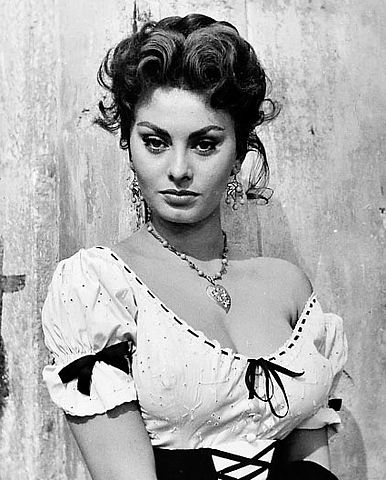
Facts about Sophia Loren
Sophia was born in the city of Rome on September 20, 1934. Her parents were Riccardo Scicolone and Romilda Villani.
Sophia is considered one of the most voluptuous actresses in the history of cinema, curiously as a child she was so thin that she was nicknamed "toothpick".
In 1999, Sophia Loren filed a lawsuit against 76 websites for using "fraudulent photographs" of her on adult sites.
In 1966 Sophia married Carlo Ponti, after their first marriage in 1957 was invalid under Italian law.
Sophia Loren's children are Carlo Ponti Jr. and Edoardo Ponti.
In 1982 Sophia Loren spent 18 days in prison for evading taxes.
Sophia suffered from stage fright which prevented her from acting in theatrical productions.
In 1991 People magazine chose her as one of the 50 Most Beautiful People in the world.
Sophia's sister, Anna Maria Scicolone, was once married to Benito Mussolini's son, Romano. Their daughter, Alexandra, is a controversial figure in Italian politics.
.
Facts about Rabindranath Tagore
Rabindranath Tagore was born in Calcutta, India on 7 May 1961.Rabindranath Tagore was the first writer from Asia to win the Nobel Prize for literature in 1913.
The national anthems of both Bangladesh and India originate in two songs by Rabindranath Tagore: the Amar Shonar Bangla and the Jana Gana Mana.
Rabindranath's parents were Debendranath Tagore and Sarada Devi.
In 1883 Rabindranath Tagore married Mrinalini Devi with whom he would have 5 children.
In 1915 Tagore was knighted by the British Crown, but he got rid of such recognition in 1919, after the massacre committed against the independence movement of India.
Rabindranath Tagore wrote more than 3,000 songs throughout his life. He also wrote novels, short stories, theatre and poems.
Facts about Dante Alighieri
The word 'divine' was first added to the 1555 edition of The Divine Comedy; the original title was simply The Comedy.Dante Alighieri was born in 1265 in the city of Florence.
In 1274, at the age of nine, Dante meets for the first time Beatriz Portinari, who would provide the inspiration for his major works.
The Divine Comedy has been illustrated by Sandro Botticelli, Michelangelo, John Flaxman, William Blake, Gustave Doré, and Salvador Dalí, and has inspired the music of Tchaikovsky, Giovanni Pacini, and Franz Liszt.
Dante Alighieri considered the Latin poet Virgil one of his most important influences, so much so that in the Divine Comedy he was the character who guided the poet on his journey through Hell and Purgatory. While Beatriz, muse and beloved poet of Dante, was his guide in Heaven.
In 1292 Dante wrote Vita Nuova.
In 1277 Dante Alighieri marries Gemma Donati, with whom he has 4 children: Jacopo, Pietro, Giovanni and Antonia.
Dante Alighieri died in September 1321.
In 2007, Italian scientists from the University of Bologna recreated Dante's royal face. The model is believed to be the closest to its true appearance. A portrait made by Botticelli was used as a base next to the skull.
The sculpture known as Rodin's Thinker was originally baptized by Rodin as Dante thinking of the gates of hell. Although it is popularly known as The Thinker.
The iconography of Auguste Rodin's The Gates of Hell is based on Dante's The Divine Comedy and Baudelaire's poems from his The Flowers of Evil, trying to make a great allegory of love and condemnation.
The Heavy Metal band, Iced Earth has as one of its top works the song Dante`s Inferno that lasts 16 minutes and is based on the Divine Comedy.
.
Facts about Michelangelo
The Renaissance artist Michelangelo was born on 6 March 1475 in Caprese, Italy.Michelangelo Buonarroti was a celebrated poet during his lifetime; more than 300 poems of his authorship survive.
The Piety (Pietà) found in the Vatican is the only work by Michelangelo that is signed by him. He did so one night by sneaking into St. Peter's Basilica, engraving his name on the sculpture so that no one doubted his authorship.
Pope Julius II had originally commissioned Michelangelo to paint on the ceiling of the Sistine Chapel the image of the twelve Apostles.
From 1501 to 1504 Michelangelo sculpted The David, which despite its monumental size is remarkable for its subtle balance between strength and vulnerability.
The Florentine artist was known for his strong character and sullen treatment.
His contemporaries used to call him Il Divino.
Michelangelo never married.
Michelangelo used to spend months in the quarries choosing the marble blocks for his sculptures.
Michelangelo died on February 18, 1564. He was the first Western artist whose biography was published in life.
Facts about Cervantes
It was in Alcalá de Henares where Miguel de Cervantes Saavedra, known as the prince of ingenuity, was born.The ingenious nobleman Don Quixote de la Mancha is considered the first modern novel, and the greatest work of Spanish literature and one of the best in world history.
Cervantes, though eager to write poetry, never considered himself a good poet, and even lamented it. Here are some of his own verses on the subject:
I always work and wake up
for seeming to be a poet.
the grace that heaven didn't want to give me
Cervantes lost the mobility of his left hand in the battle of Lepanto, when a piece of lead severed a nerve. Hence the nickname of the Lepanto´s one-armed.
Both the wound on his hand and his participation in the battle of Lepanto was a source of great pride for Cervantes. In the prologue of the second part of Don Quixote he wrote: the highest occasion that the past centuries saw, the present ones, nor do they expect to see the future ones.
Cervantes suffered 5 years of captivity in Algiers; during that time he tried to escape unsuccessfully on 4 occasions from prison. In 1580, Friar Juan Gil, a Trinitarian father, paid the five hundred gold escudos they were asking for the ransom of Cervantes.
In 1597 Cervantes was imprisoned in the Royal Prison of Seville for alleged mishandling as a tax collector. In the solitude of the prison Cervantes conceives his Quixote.
In 1605 Miguel de Cervantes published the first part of the Ingenious Hidalgo Don Quixote de la Mancha, the first edition of which was soon sold out.
Don Quixote was conceived by Cervantes as a parody of the books of chivalry.
The second part of Don Quixote was published in 1615, one year before Cervantes' death.
The great English writer William Shakespeare came to read the first part of Don Quixote de la Mancha.
There is a common place, that both Cervantes and Shakespeare died on the same date (April 23, 1616); however Cervantes died on April 22, being buried on April 23, while Shakespeare's England then governed the Julian calendar, so in reality Shakespeare's death occurred on May 3.
.
Facts about Russian composer Tchaikovsky
Pyotr Ilyich Tchaikovsky was born in Votkinsk, Russia, on May 7, 1840.In 1869 Tchaikovsky composed the Fantasy-Overture Romeo and Juliet, which he would still revise in 1870 and 1880.
In 1875 Tchaikovsky composed Piano Concerto No. 1.
In 1876 he completed the Swan Lake ballet.
Tchaikovsky befriended a wealthy widow named Nadezhda von Meck, who would support him financially for the next 20 years.
In 1889 he composed the ballet Sleeping Beauty.
Tchaikovsky completed the Nutcracker ballet in 1892.
Symphony No. 6 (Pathetic) was premiered in 1893.
Tchaikovsky and her patron, Nadezhda von Meck, conducted their relationship solely on the basis of correspondence during the years she sponsored it.
Tchaikovsky's marriage in 1877 was an immediate disaster, and shortly after his marriage he made arrangements never to see his wife again.
The cause of Tchaikovsky's death is still uncertain: Some authorities believe that his death was accidental, but others contend that he purposely took arsenic or drank water infected with cholera.
His brother Modest was a playwright and librettist who wrote a biography of Tchaikovsky.
Above any other composer, Tchaikovsky adored Mozart. He even once referred to him as "the Christ of music. Of other composers, Wagner bored him while detesting Brahms.
Tchaikovsky struggled with his sexuality and worked hard to keep his homosexuality a secret.
.
Interesting facts about Giuseppe Verdi
The great Italian composer, Giuseppe Verdi, was born on 10 October 1813. His parents were Carlo Verdi and Luigia Uttini.Verdi was characterized in his operas as a highly expressive composer.
At the early age of 3 Verdi already began to play the keyboard.
Giuseppe Verdi is famous for his themes of freedom, heroism and love, great feelings that are evident in his works. He not only composed operas but also marches, symphonies, ecclesiastical and secular music.
Giuseppe Verdi married at the age of 22 Barezzi's daughter, Margherita, with whom he had two children, who unfortunately died at an early age.
Verdi was accused, for his work in his opera Othello, of copying Wagner's style. These accusations were unfounded.
After his first wife died, Verdi married Giuseppina Strepponi, a soprano.
Some of Giuseppe Verdi's most important operas are: Rigoletto, La Traviata and Il Trovatore. Which compose his romantic trilogy.
The conservatory of Milan, which had denied him his entry as a young man, wanted to be renamed with the name of the composer himself, thanks to his popularity and success in his maturity, to which he replied: "They did not want me as a young man, I do not know why they want me as an old man". Today the conservatory bears his name.
Verdi dies in Milan, on January 27, 1901, due to a stroke. A large crowd in the funeral procession will sing the chorus of the slaves of Nabucco ("Va pensiero sull'ali dorate").
.
Facts about composer Franz Schubert
It was in Vienna, the city where Franz Schubert, one of the most gifted composers of the 19th century, was born.Schubert (January 31, 1797) was the twelfth of 13 brothers. The family lived in the Liechtental district.
His music teacher soon became aware of his talent and went so far as to say to him: "I have nothing more to teach you, knowledge you have received from the good God".
Shubert's beautiful voice allowed him to enter the choir of the Imperial Chapel and the Royal Seminary, where he would later study composition with Salieri.
Franz Schubert composed his first symphony in 1813.
Schubert composed more than 600 songs (lieder), many of them inspired by poems by Goethe, Schiller, and Heine.
In October 1822, Schubert began his famous Symphony in B minor, commonly called The Unfinished.
Except for a circle of admirers who were among the most notable artists of the period, Schubert gained little recognition before his death, and generally lived in economic hardship.
During his lifetime Franz Schubert could not premiere any of his operatic or orchestral works.
Franz Schubert got a job as a private music teacher for the children of a Hungarian nobleman.
The schubertiadas were gatherings of artists who formed a bright, festive circle dedicated to music and reading, where the central figure was Schubert.
Franz Schubert lived only 31 years, a syphilis, finally complicated with a typhoid fever, led him to death on November 19, 1828. In so few years Schubert managed to compose a musical work excellent for its great beauty and inspiration.
.
.
14 Facts about Vivaldi, Italian composer
It was in the city of Venice where Antonio Lucio Vivaldi was born on March 4, 1678.
Antonio Vivaldi is known by the nickname of Il Prete Rosso (The Red Priest) because he was a redhead and priest of the church.
Vivaldi suffered from asthma. Many times he had to give up when he was celebrating mass because of his frequent attacks.
When the cardinal excused him from officiating more masses because of asthma, Vivaldi got a job as a music director at a school for orphaned girls.
One of his musical works, Arsilda regina di Ponto, was initially censored because of a supposed lesbian content.
Vivaldi had several affairs, one of which was with the singer Anna Giraud.
The Italian composer composed the wedding music of King Louis XV of France.
The Austrian Emperor Charles VI was so fond of Vivaldi's music that he named him a knight.
Vivaldi composed more than five hundred concerts, apart from operas and sacred music.
Johann Sebastian Bach admired Vivaldi's music so much that he transcribed several of his works.
When Vivaldi died in 1741 his music remained in the most complete darkness. It was Bach's 19th century scholars who first heard of Vivaldi, thanks to the ancient manuscripts where Bach had transcribed the concerts of someone named Vivaldi. It was known who Bach was, but who was Vivaldi? Fortunately a search was carried out, which resulted in Vivaldi being rescued from oblivion.
Antonio Vivaldi was born and died in the period of baroque music.
At Vivaldi's funeral in Vienna's cathedral, children from the cathedral's choir, including future composer Joseph Haydn, sang.
Antonio Vivaldi's most famous work is the concerts of the Four Seasons.
.
Subscribe to:
Posts (Atom)